The Death of the Waiting Room: Why Smart Hospitals Are Hiring "Chief AI Officers"
Key Takeaways: The Smart Hospital of 2026
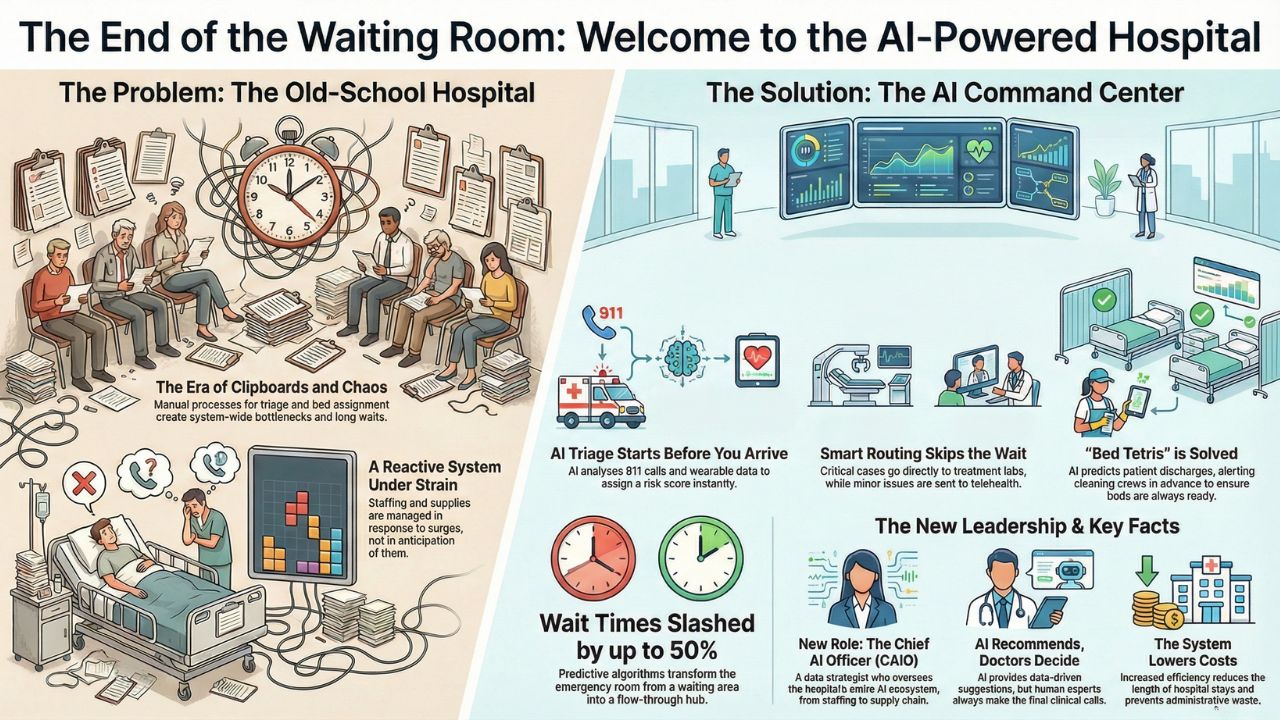
- Zero Wait Times: AI algorithms now pre-triage patients before they even enter the building, slashing ER wait times by 35-50%.
- The "Traffic Control" Tower: Hospitals now use centralized command centers where AI monitors every single bed, ambulance, and operating room in real-time.
- Predictive Staffing: Instead of reacting to a flu surge, AI predicts it 48 hours in advance, ensuring nurses are already on shift.
- The New C-Suite Role: The "Chief AI Officer" is now as critical as the Chief of Surgery.

No More Clipboards, No More Chaos
We have all been there. You walk into an Emergency Room, in pain, and are handed a dirty clipboard.
Then you sit. And wait. And wait some more.
In 2026, that era is ending. The modern AI hospital management system doesn't just digitize the clipboard; it removes the waiting room entirely.
This shift from "reactive" to "predictive" care is a fundamental part of our extensive guide on The Clinical AI MedTech Revolution: How Algorithms Are Saving Lives.
AI Triage: The Nurse’s Super-Assistant
The bottleneck in every ER is the Triage Station. A human nurse has to manually assess every patient.
Today, patient triage AI starts working the moment you call emergency services.
By analyzing voice stress levels during the 911 call and integrating with wearable data (like your Apple Watch or Oura Ring), the hospital knows your vitals before the ambulance arrives.
How it works:
- Severity Scoring: The AI assigns a risk score instantly.
- Direct Routing: Heart attack patients go straight to the Cath Lab, skipping the waiting room entirely.
- Low-Acuity Filtering: Minor cases are automatically routed to telehealth kiosks, keeping beds open for real emergencies.
Bed Tetris: Solving the Capacity Crisis
The second reason you wait? No open beds.
Hospitals used to run on whiteboards and phone calls. Now, they run on Smart Hospital technology.
Algorithms now manage bed turnover with the precision of air traffic control.
The AI predicts exactly when a patient in Room 304 will be discharged and alerts the cleaning crew 30 minutes prior. This ensures that the bed is clean and ready the second a new patient needs it, reducing "bed blocking" by hours every day.
Meet the "Chief AI Officer" (CAIO)
Ten years ago, this job didn't exist. Today, it is essential.
The CAIO isn't a doctor. They are a data strategist responsible for the "Central Command Center."
They oversee the algorithms that control:
- Staffing Levels: Predicting sick calls and patient surges.
- Supply Chain: Ordering life-saving drugs automatically before stock runs out.
- Data Flow: Ensuring the AI Radiology Tools talk to the surgical robots seamlessly.
However, connecting everything to a central brain brings risks.
Efficiency is critical, but what happens if that central brain gets too invasive?
We explore the dangers of data centralization in our report: The Algorithm Denied My Surgery: AI Privacy Risks & Hidden Bias.
Conclusion: The Invisible Hospital
The best hospital experience is the one you don't remember.
You shouldn't remember the paperwork, the waiting, or the confusion.
With AI for healthcare administration, the logistics become invisible. You walk in, you get treated, and you recover.
The "Chief AI Officer" ensures that the only thing the doctors have to focus on is you.
Frequently Asked Questions (FAQs)
No. The AI acts as a recommendation engine. It suggests priority based on data, but a human Triage Nurse or Doctor always makes the final call on admission.
It actually lowers it. By reducing the length of stay and preventing administrative bottlenecks, hospitals save millions, savings that (ideally) slow the rise of insurance premiums.
Redundancy is key. Smart hospitals operate on "Edge Computing" systems. This means even if the internet goes down, the local hospital server keeps the critical AI triage tools running without interruption.
Sources & References
- HIMSS (Healthcare Information and Management Systems Society): The State of Healthcare AI: 2025 Report on Clinical Operations.
- Deloitte Insights: The Smart Hospital of the Future: How AI is transforming patient flow.
- National Institutes of Health (NIH): Impact of Artificial Intelligence on Emergency Department Wait Times: A Systematic Review.