Top Tools for AI Agent Evaluation 2026: Managing Autonomous Teammates
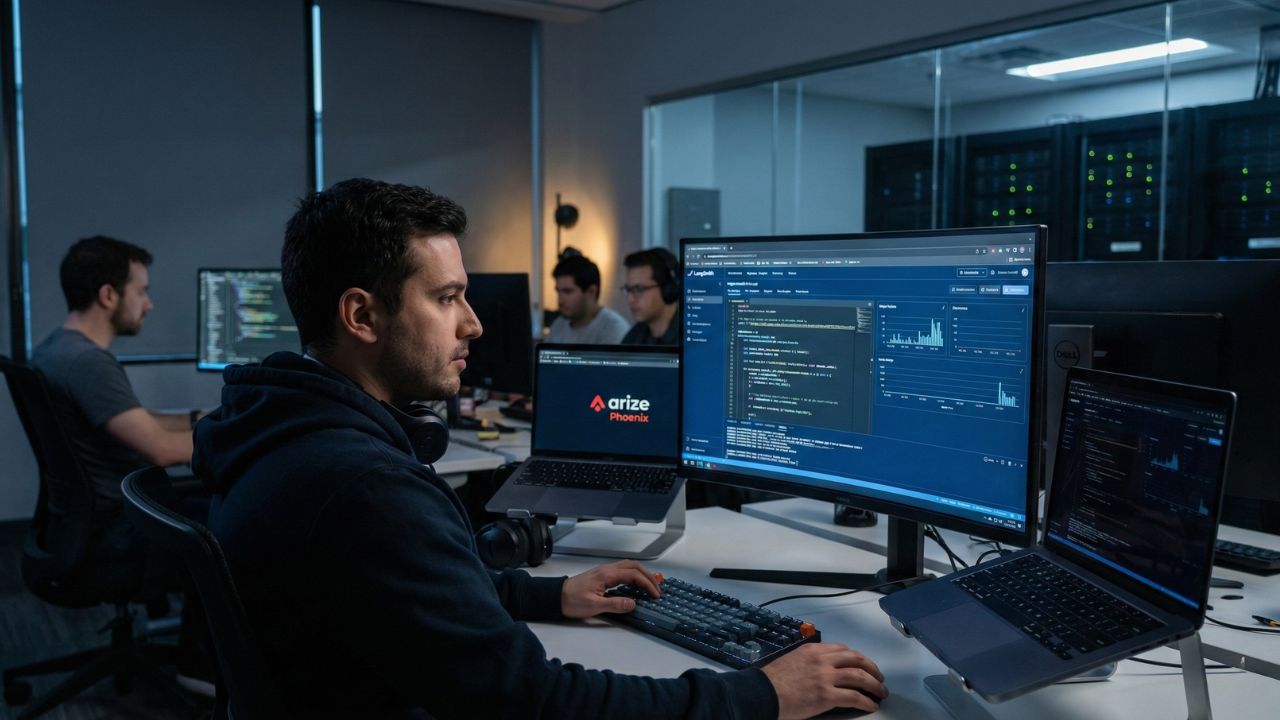
Quick Answer: The 2026 Evaluation Stack
- For Deep Tracing: LangSmith remains the gold standard for visualizing complex agentic loops and reasoning chains.
- For Open Source: Arize Phoenix offers best-in-class local observability, perfect for developers prioritizing privacy.
- For Production Safety: Guardrails AI implements critical "circuit breakers" to stop agents from executing dangerous commands.
- The Metric Shift: In 2026, we moved from measuring "accuracy" to measuring "success rates" and "steps-to-solution."
From Chatbots to Teammates: The Observability Crisis
In 2026, we aren't just prompting chatbots; we are hiring autonomous agents.
But managing an agent that has write-access to your database is terrifying without the right oversight. Unlike traditional software, agents are probabilistic. They drift. They hallucinate. They get stuck in infinite loops.
To trust them, you need to watch them think.
This deep dive is part of our extensive guide on Live Leaderboard 2026: Gemini 3 Pro vs. DeepSeek vs. GPT-5.
While benchmarks tell you how smart a model is, the top tools for AI agent evaluation 2026 tell you if your specific agent is actually doing its job.
1. LangSmith: The Industry Standard
If you are building with LangChain or LangGraph, LangSmith is non-negotiable. It provides "X-Ray vision" into your agent's brain. When you are evaluating agentic reasoning traces to debug why a coding bot failed, LangSmith allows you to replay the exact sequence of thoughts and tool calls.
Why it dominates:
- Full Traceability: See exactly which step in a 10-step reasoning chain failed.
- Regression Testing: Run dataset tests on every new prompt version to ensure you haven't broken existing functionality.
- Cost Tracking: Monitors token usage per agent run, which is critical given the Cost of Running LLM Locally vs Cloud.
2. Arize Phoenix: The Open Source Contender
For developers who prefer Best Open Source Tools for Running Local LLMs, Phoenix is the go-to choice. It is notebook-first and runs entirely on your machine.
Key Features:
- Embedding Analysis: Visualizes your retrieval clusters to see why your agent picked the wrong document.
- Local Evaluation: Uses a smaller, local LLM (like Llama 3) to "grade" the outputs of your larger agent, automating QA without sending data to the cloud.
3. Weights & Biases (W&B): The Enterprise Audit
When an agent goes into production, you need W&B. It excels at detecting "Drift", when an agent's performance slowly degrades over weeks because the underlying model changed or user inputs shifted.
The "Circuit Breaker" Feature: W&B integrates with governance tools to freeze agent permissions if error rates spike. This is a core component of any Enterprise AI Governance Framework 2026.
4. AgentOps: The "Crash Reporter" for AI
Agents fail in unique ways. They get stuck in loops or call tools with invalid arguments. AgentOps is designed specifically to catch these operational failures.
- Session Replay: Watch a video-like replay of the agent's terminal interactions.
- Time-to-Success metrics: Measures how long an agent took to solve a problem, not just if they solved it.
Conclusion
Building an agent is easy in 2026. Trusting it is hard. Without the top tools for AI agent evaluation 2026, you are essentially letting a junior employee work without supervision.
By implementing a stack like LangSmith for dev and Arize Phoenix for local testing, you turn "black box" magic into reliable engineering.
Compare Market Intelligence Tools. Try SimilarWeb

We may earn a commission if you buy through this link. (This does not increase the price for you)
Frequently Asked Questions (FAQ)
LangSmith is currently the most robust platform for tracing multi-step agent workflows, offering deep integration with the LangChain ecosystem.
You use "LLM-as-a-Judge." Tools like Arize Phoenix allow you to use a superior model (like GPT-5) to grade the reasoning steps of a smaller agent (like Llama 3).
Platforms like Weights & Biases track evaluation metrics over time. If the "success rate" of your coding agent drops from 90% to 80%, the system alerts you to investigate model drift.
The top KPIs are Success Rate (did it complete the task?), Steps-to-Solution (efficiency), and Cost-per-Task (token consumption vs. human labor cost).
Only with "Human-in-the-loop" oversight. Using tools like LangGraph, you can require human approval before the agent executes a high-stakes action (like deploying code).
Sources & References
- Live Leaderboard 2026: Gemini 3 Pro vs. DeepSeek vs. GPT-5
- Cost of Running LLM Locally vs Cloud
- LangSmith Documentation & Cookbook
- Arize Phoenix GitHub Repository
Internal Analysis:
External Analysis: