Why Your Devin AI Alternatives 2026 Choice Will Fail
Executive Snapshot: The Bottom Line
- The Silent Cost: 90% of Devin AI alternatives 2026 fail at multi-file refactoring, drastically increasing the burden on your human QA team.
- Context Degradation: Autonomous agents lose the plot after 5-6 iteration loops, leading to codebase rot.
- The Metric that Matters: Do not judge an agent by its demo; judge it purely by its verified resolution rate on the SWE-bench.
Everyone wants an autonomous AI software engineer, but blindly deploying these agents usually results in a tangled mess of broken builds and hallucinated dependencies.
You are likely evaluating tools to automate your sprint backlog, only to realize these bots are creating more pull requests for your senior engineers to clean up than they actually resolve.
To truly scale without breaking your repository, you must stop treating these tools as magical junior developers and start treating them as high-risk, high-reward compilation pipelines.
As detailed in our master guide on Vibe Coding 101: How AI is Replacing Syntax with Intuition in 2026, the industry shift toward autonomous coding requires a fundamental change in how we review and merge code.
Decoding the SWE-Bench Reality
If you are looking for an AI coding agent similar to Devin cognition, the marketing pages will lie to you.
Every new open-source GitHub repository claims it can build a full-stack application from a single prompt.
In reality, enterprise software development is about modifying existing, deeply entangled legacy systems.
This is why engineering leaders rely heavily on swe-bench rankings to cut through the noise.
SWE-bench evaluates how well an agent can resolve real, complex GitHub issues in large Python repositories.
If an open source autonomous developer cannot navigate a codebase it didn't write, it is useless for B2B applications.
The Open-Source vs. Proprietary Showdown
When comparing swe-agent vs devin, the differences lie in the architecture of their terminal access and reasoning loops.
Below is the unvarnished reality of current capabilities.
| Agent Framework | SWE-Bench Lite Pass Rate | Primary Architecture | Enterprise Viability |
|---|---|---|---|
| Cognition Devin | ~30% (Estimated) | Proprietary Cloud | High (Fully Managed) |
| SWE-Agent | ~18% | Open Source | Medium (Requires Tuning) |
| OpenDevin | ~15% | Open Source | Medium (Local Control) |
| Copilot Workspace | N/A (Human-in-loop) | Hybrid | High (Enterprise Safe) |
Expert Insight: Do not deploy an autonomous agent on a repository without 90% unit test coverage. An agent without strict, automated test boundaries will confidently rewrite working logic and silently deploy breaking changes to staging.
The Hidden Trap: Context Rot and the "Infinite Loop"
What most teams get wrong about Devin AI alternatives 2026 is assuming the agent knows when to stop.
When a human developer hits a blocker, they ask for clarification.
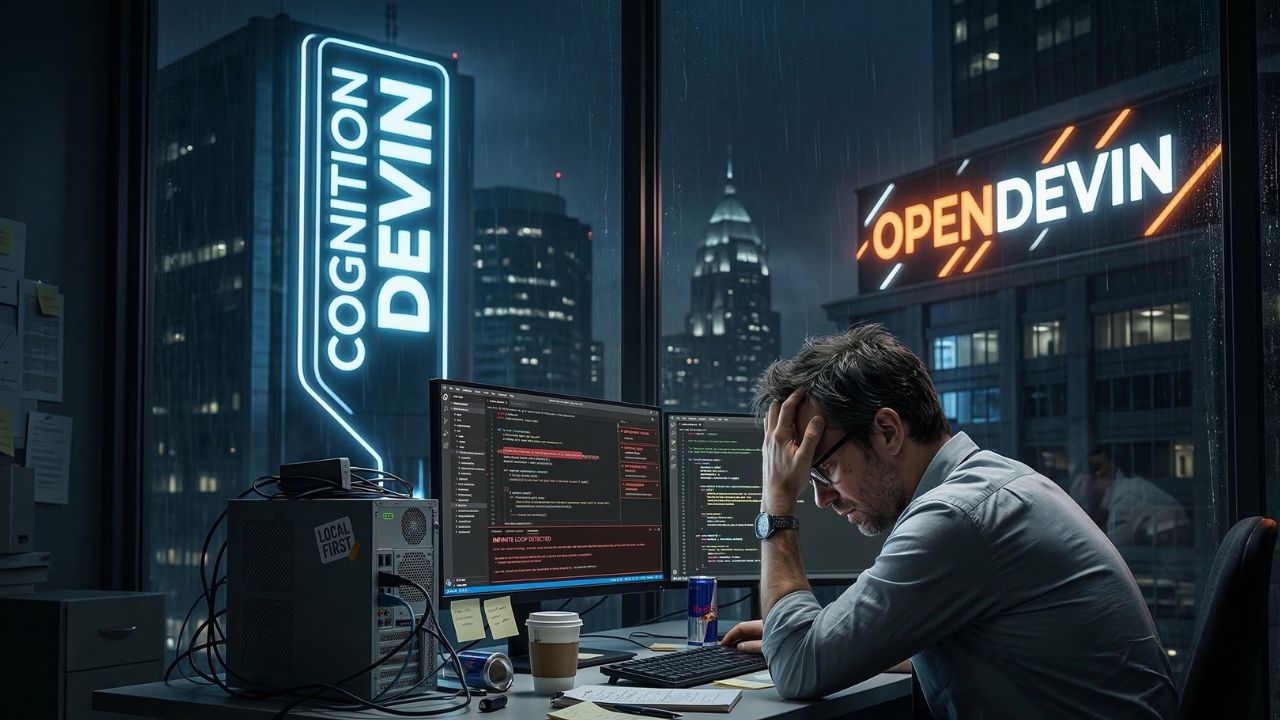
When an autonomous agent hits a blocker, it often hallucinates a new library, breaks a dependency, and enters an "infinite loop" of writing code to fix the errors it just created.
This leads to catastrophic codebase pollution. We refer to this as context rot.
If you are struggling with this specific deployment nightmare, you must urgently implement a strategy for managing agentic technical debt before your pipeline freezes entirely.
Architecting a Failsafe Agentic Pipeline
To extract actual ROI from these tools, you must build guardrails around them.
Follow this step-by-step framework to safely integrate an autonomous developer into your workflow.
Step 1: The Docker Sandbox
Never give an agent bare-metal or root access. Run all open-source alternatives inside ephemeral, tightly controlled Docker containers with zero production database access.
Step 2: Token Limits and Loop Caps
Hardcode a maximum iteration limit (e.g., 5 attempts). If the agent cannot resolve the GitHub issue within 5 compilation attempts, kill the process and flag it for human intervention.
Step 3: The "Draft PR" Rule
Agents must only push to isolated branches and generate "Draft PRs."
They must pass all CI/CD linters and automated tests before a senior human engineer is even pinged for a code review.
Conclusion: Own Your AI Strategy
Your choice of Devin AI alternatives 2026 will fail if you treat it as a plug-and-play employee.
It is not an employee; it is a highly volatile automation script.
Stop seeking a magical solution that requires zero oversight. Instead, choose the agent that integrates most cleanly into your existing CI/CD pipeline, enforce strict testing boundaries, and watch your team's velocity double without sacrificing architectural integrity.
Create your AI videos. Try HeyGen AI
We may earn a commission if you buy through this link. (This does not increase the price for you)
Frequently Asked Questions (FAQ)
The top open-source Devin alternatives currently include SWE-Agent and OpenDevin. These robust frameworks allow engineering teams to run agentic coding workflows locally, offering high customization and continuous community-driven updates without the expensive enterprise lock-in associated with proprietary platforms.
SWE-Agent uses a highly optimized agent-computer interface tailored specifically for navigating repositories. While Devin offers a polished, fully managed cloud experience, SWE-Agent remains highly competitive on the SWE-bench benchmarks, making it a powerful, cost-effective alternative for resolving complex GitHub issues.
Yes, several open-source projects act as free alternatives. Frameworks like OpenDevin and SWE-Agent are entirely free to use, though you are still responsible for paying the API costs of the underlying language models (like GPT-4o or Claude 3.5) powering their reasoning.
Yes, OpenDevin can be configured to run entirely locally if paired with powerful open-weights models like Llama-3 or DeepSeek-Coder running via Ollama. This setup guarantees maximum data privacy, though local models may struggle with highly complex, multi-file reasoning tasks.
For strict enterprise security, GitHub Copilot Workspace and locally hosted OpenDevin instances are optimal. They allow companies to keep proprietary code within their secure perimeters, ensuring compliance with data governance policies by preventing codebase exposure to external cloud providers.
Currently, most autonomous agents struggle with massive, repository-wide refactoring. They often suffer from context window degradation, losing track of architectural intent. They perform best when tasks are tightly scoped to specific modules, backed by comprehensive, automated unit testing frameworks.
Yes, but with a different philosophy. Copilot Workspace acts as a highly agentic, human-in-the-loop alternative. Instead of operating entirely autonomously in the background, it proposes comprehensive, multi-file execution plans that the developer must review and steer before final implementation.
Running agentic AI locally requires substantial compute. You need at least an Apple M-series chip with 32GB of unified memory or a dedicated Nvidia GPU (RTX 3090/4090 with 24GB VRAM) to run 30B+ parameter coding models efficiently without severe latency.
You must isolate their execution environment. Restrict their access to ephemeral Docker containers, enforce strict token and iteration limits, and require all agent-generated code to pass automated CI/CD pipelines before submitting a pull request for mandatory human review.
Pass rates fluctuate rapidly as models update. Currently, proprietary models utilizing Claude 3.5 Sonnet or advanced OpenAI architectures lead the leaderboard, while optimized frameworks like SWE-Agent represent the highest tier of open-source performance on the rigorous SWE-bench evaluation framework.
Sources & References
- Princeton University NLP Group: SWE-bench: Can Language Models Resolve Real-World GitHub Issues? (2025).
- Stanford Institute for Human-Centered Artificial Intelligence (HAI): AI Index Report: The Evolution of Autonomous Software Engineering Agents. (2025).
- Gartner Research: Strategic Automation: Managing the Risks of Agentic AI in Enterprise CI/CD Pipelines. (2026).
- Vibe Coding 101: How AI is Replacing Syntax with Intuition in 2026
- Managing agentic technical debt
External Sources
Internal Sources