Deploying LangGraph at Scale: The Enterprise K8s and AgOps Blueprint
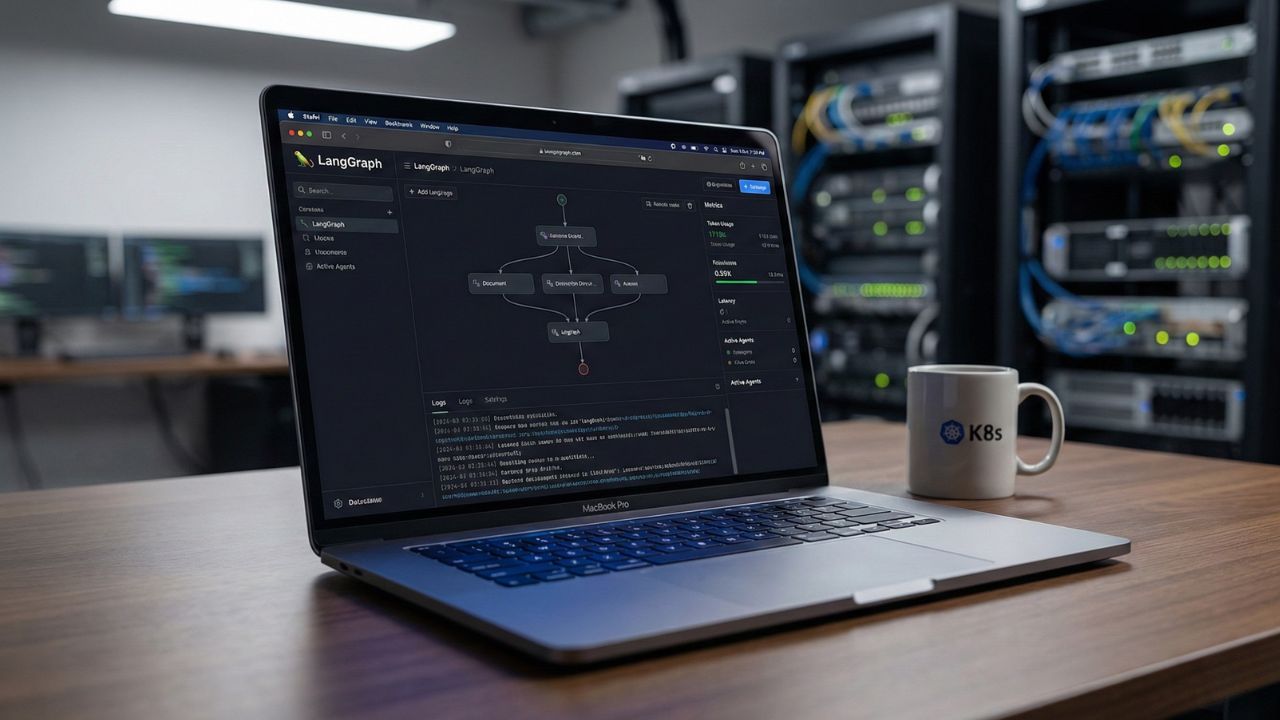
Key Takeaways:
- Agentic Operations (AgOps) replaces traditional DevOps when managing non-deterministic AI workflows.
- Kubernetes (K8s) provides the elastic infrastructure necessary to handle dynamic, concurrent agentic loops.
- Scalable Memory Persistence requires robust, high-throughput databases to manage complex graph check-pointing.
- Strict Observability via circuit breakers and token monitoring is mandatory to prevent runaway costs.
- Compliance Frameworks like ISO/IEC 27001 and NIST SP 800-218 must dictate your architecture from day one.
A "demo" agent running locally on your laptop is relatively easy to build. However, managing 10,000 agents handling live, sensitive customer data is an entirely different beast.
When you are deploying LangGraph at scale, you are no longer just writing prompts; you are architecting a highly available, distributed system.
This deep dive is part of our extensive guide on the Agentic AI Architecture.
In this blueprint, we will explore the AgOps methodologies and Kubernetes integrations required to securely scale your enterprise swarms.
The Evolution: From DevOps to AgOps
When transitioning to multi-agent architectures, traditional deployment pipelines fall short. Agents are non-deterministic and require specialized operational strategies.
What changes when scaling agents? Traditional DevOps monitors CPU and memory. AgOps (Agentic Operations) must monitor token consumption, LLM latency, and agent reasoning paths.
You must establish robust continuous evaluation pipelines. This ensures that an updated system prompt does not trigger unexpected behavior in a production environment.
Implementing Circuit Breakers
Infinite loops are the fastest way to drain your AI budget. In a cyclic graph architecture, agents can easily get stuck in a "retry" spiral.
Iteration Limits: Always set a strict hard cap on the maximum number of steps an agent can execute within a single graph run.
Cost Ceilings: Implement API gateways that automatically cut off agent access if token spend exceeds a predefined hourly threshold.
Human-in-the-Loop Fallbacks: Configure nodes to halt and request human approval for high-stakes or high-uncertainty decisions.
Kubernetes (K8s) Architecture for Multi-Agent Swarms
To handle unpredictable workloads, container orchestration is non-negotiable. Kubernetes provides the ideal foundation for scaling LangGraph applications.
Deploying LangGraph agents on Kubernetes requires packaging your agentic workflows into stateless microservices.
This allows K8s to spin up new pods dynamically based on incoming traffic.
Managing High-Concurrency Loops
Can LangGraph handle 10,000 concurrent agentic loops? Absolutely, provided your infrastructure is designed to scale horizontally.
Event-Driven Autoscaling: Use tools like KEDA (Kubernetes Event-driven Autoscaling) to scale agent worker pods based on queue length (e.g., Redis or Kafka).
Resource Quotas: Strictly define CPU and memory limits for your pods to prevent a single "rogue" agent from starving your cluster.
If you are exploring secure sandbox execution for coding tasks, review our Browser Operator Agent System Design for container isolation best practices.
State Management and Memory Persistence
LangGraph relies heavily on state management. As your user base grows, persisting this state becomes a significant database engineering challenge.
Best practices for scaling multi-agent systems in production involve decoupling your agent logic from your state storage.
Strategies for 1M+ Users
The best database for agent state persistence at scale is typically a high-performance key-value store or a specialized PostgreSQL instance.
- PostgreSQL with pgvector: Excellent for long-term semantic memory and structured state checkpoints.
- Redis: Ideal for ultra-fast, short-term conversational state retrieval to minimize latency.
Compliance: Ensure your database encryption and access controls map directly to ISO/IEC 27001 and NIST SP 800-218 standards to protect user interactions.
For insights into how different frameworks manage memory and logic, check out our comparison on CrewAI vs LangGraph.
Token Observability and Latency Reduction
Enterprise deployments demand rigorous cost optimization for large-scale LangGraph deployments. You cannot improve what you do not measure.
Monitoring token usage in large-scale agent swarms requires dedicated observability platforms (like LangSmith or customized Datadog dashboards).
Tagging: Assign specific tags to every graph invocation to track costs by customer, department, or specific agent node.
Caching: Implement semantic caching to intercept duplicate queries before they hit the expensive foundational models.
Optimizing DAG Performance
Reducing latency in complex LangGraph directed acyclic graphs (DAGs) is critical for user experience.
Parallel Execution: Identify independent nodes within your graph and configure them to execute concurrently using asyncio.
Model Routing: Route simpler sub-tasks to faster, cheaper models (like Claude 3.5 Haiku) and reserve complex reasoning for larger models.
Conclusion
Transitioning an AI prototype into a highly available enterprise service requires discipline.
By deploying LangGraph at scale using robust K8s orchestration and strict AgOps practices, you build a resilient, cost-effective infrastructure.
Mastering these operational pillars ensures your agentic workflows remain secure, scalable, and fully compliant with modern enterprise standards.
Scale Securely with Proven Tools. Try Similarweb
We may earn a commission if you buy through this link. (This does not increase the price for you)
Frequently Asked Questions (FAQ)
Deploy them as stateless containerized microservices. Use Helm charts to manage deployments and utilize an event-driven autoscaler like KEDA to spin up worker pods based on task queue volume.
Decouple state from logic, implement strict token monitoring, use semantic caching, and enforce hard iteration limits to prevent infinite cyclic loops.
Utilize a distributed, high-throughput database like PostgreSQL for persistent checkpointing, paired with Redis for rapid access to active session states.
Integrate observability tools like LangSmith or custom telemetry to tag and trace every graph run, allowing you to aggregate token consumption by user, node, or specific workflow.
Execute independent nodes in parallel asynchronously, optimize your database read/write speeds, and dynamically route simple tasks to smaller, faster language models.
While DevOps focuses on uptime and code delivery, AgOps (Agentic Operations) adds continuous evaluation of non-deterministic LLM outputs, token cost management, and reasoning path tracing.
Yes, if architected correctly. It requires horizontal scaling on Kubernetes, an asynchronous execution environment, and an enterprise-grade database to handle the massive influx of state updates.
A highly tuned PostgreSQL database (often leveraging JSONB columns and pgvector) is generally the gold standard for reliable, scalable, and queryable state persistence.
Hardcode maximum iteration counts within your graph definitions and use API gateway policies to automatically block requests if an agent exceeds a predefined cost or time threshold.
Use semantic caching to prevent redundant API calls, route tasks to the most cost-effective model based on difficulty, and meticulously trace and trim unnecessary prompt context.
Sources & References
- Official GitHub Repository: Agentic AI Architecture: The Engineering Handbook
- NIST Special Publication 800-218: Secure Software Development Framework (SSDF) guidelines
- Kubernetes Event-driven Autoscaling (KEDA)
- ISO/IEC 27001 Information Security Management
- Agentic AI Architecture: The Engineering Handbook
- CrewAI vs LangGraph: A CTO's Guide
Open Source Resources:
External Sources:
Internal Sources: