How to Write a Digital Will & Contract Without a Lawyer?
Introduction: The "Lost Password" Nightmare
Imagine this: You have built a successful solopreneur business. You have $50,000 in crypto, a domain name worth $10,000, and a Substack newsletter with monthly recurring revenue.
Then, something happens to you.
Your family goes to a traditional lawyer. The lawyer looks for a paper bank book. He doesn't know what a "seed phrase" is. He can't access your 2FA. The result?
Your digital wealth vanishes into the void.
In 2026, a paper will is not enough. You need Digital Estate Planning.
This guide shows you how to use AI and smart contracts to ensure your assets are passed down instantly and securely, without paying a lawyer $5,000.
Explore the AI Wealth & Legal Defense Hub
Step 1: The "Digital Audit" (Using AI)
You can't protect what you don't track. Most people forget about their "invisible" assets.
The Tool: Wealth.com (AI Estate Manager) or Claude 3.5. Use an AI to generate a digital estate planning checklist 2026.
Prompt to use:
"I am a content creator. Generate a checklist of digital assets I need to include in my will. Include categories for Crypto, SaaS subscriptions, Domain Names, and Intellectual Property rights."
Your Asset List Should Include:
- Hardware Wallets: (Ledger, Trezor) location- never write the seed phrase in the will!
- Revenue Streams: Affiliate dashboards, AdSense accounts.
- Social Media: Instagram/TikTok handles (these are valuable IP).
- Cloud Accounts: Google Drive/Dropbox (where your life's work is stored).
Step 2: Drafting the Will (Online Will Maker with AI)
You don't need to start from scratch. New AI tools for estate management can draft valid legal text for you.
The Tool: Trust & Will or GoodTrust. These platforms act as an online will maker with AI.
They specifically ask about digital assets; which traditional lawyers often miss.
- How it works: You answer questions via a chatbot. The AI generates a legally binding state-specific will.
- Cost: ~$159 (vs. $2,000+ for a lawyer).
- Warning: A digital will needs to be printed and signed with witnesses to be valid in most courts. Electronic signatures are still risky for wills.
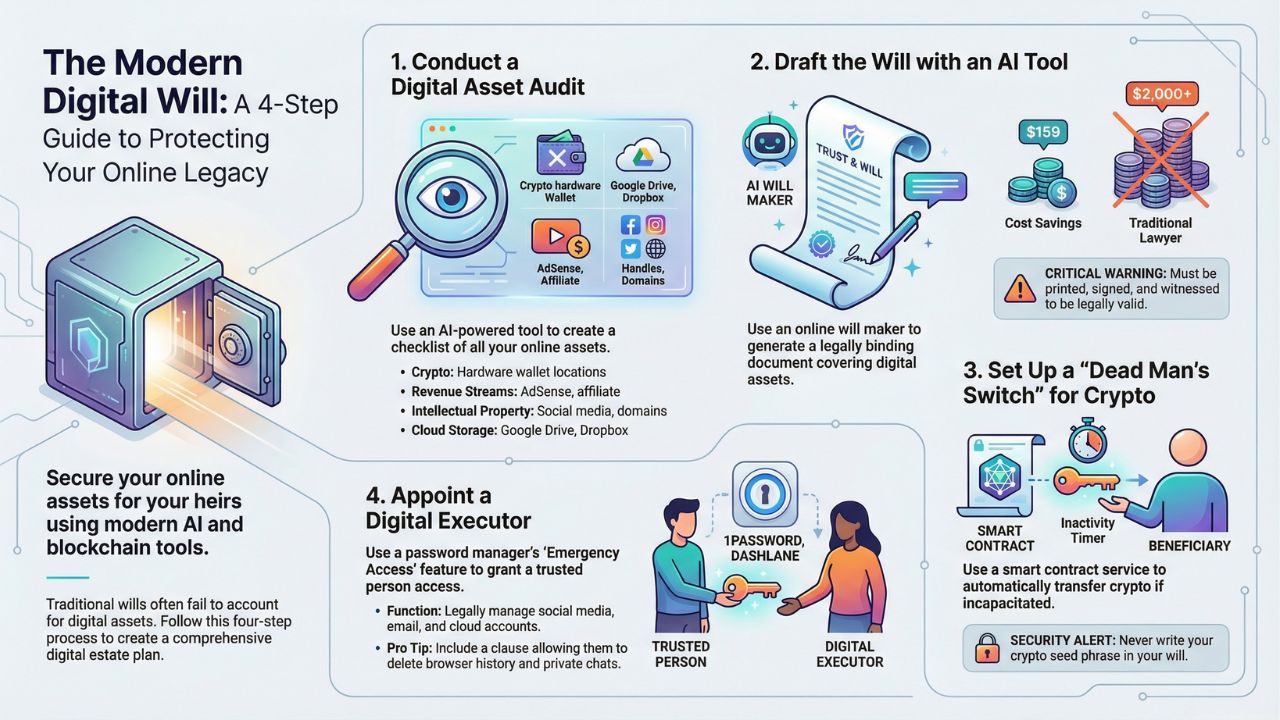 A visual breakdown of the The Modern Digital Will - A 4-Step Guide to Protecting Your Online Legacy.
Step 3: The "Dead Man's Switch" (Crypto Inheritance)
This is the "AI Fortress" level of protection. If you hold crypto, a paper will is useless because it doesn't execute trades.
You need a Smart Contract.
The Tool: Inheriti or SafeHaven. These are crypto inheritance planning tools that use blockchain technology.
- Set the Timer: You create a "SafeKey." If you don't log in for 30 days (or 1 year), the system assumes something is wrong.
- The Trigger: It automatically releases fragments of your private keys to your beneficiaries (e.g., your spouse gets 50% of the key, your lawyer gets 50%).
- The Result: Your crypto is transferred automatically without probate court.
This is a smart contract trust for inheritance, code that executes your wishes exactly as written.
Step 4: Appointing a "Digital Executor"
A normal executor pays your taxes. A Digital Executor manages your passwords.
The Strategy: Don't just give your passwords to your spouse (security risk).
Use a password manager with a "Emergency Access" feature.
Tool: 1Password or Dashlane.
Action: Set up a trusted contact. If they request access and you don't deny it within 48 hours (because you are incapacitated), they get access to your vault.
Estate Planning for Content Creators Tip: Add a clause in your will that gives your Digital Executor the right to delete your browser history and private chats. This protects your digital legacy from embarrassment.
Conclusion: Immortality Through Automation
Your legacy isn't just a pile of cash; it's the systems you built.
By using digital legacy planning software, you ensure that the business you worked so hard to build continues to support your family, even if you aren't there to run it.
You have secured your wealth, your legal rights, and your legacy.
Now, let's look at the final piece of the puzzle: Protecting your cash flow from the tax man.
Frequently Asked Questions (FAQs)
A PDF on your computer is usually not legal. However, using AI will writing software to print a document that you sign with witnesses is legal. The "Digital" part refers to the assets inside the will, not just the file format.
Never. Wills become public records after you die. Anyone could read it and steal your funds. Instead, use a secure digital asset vault or a tool like Inheriti to pass down access keys privately.
A Digital Executor is a specific person named in your will who has the legal authority to access your computer, social media, and cloud accounts. Without this, Google or Facebook may legally refuse to give your family access.
Sources and References
- Global AI Engineering Handbook 2026
- Digital Asset Inventory Guide
- Trust & Will Review (2025)
- Inheriti Protocol: Technical explanation of blockchain-based "Dead Man's Switches"
- Digital Executor Rights: Legal framework for appointing digital guardians
- 1Password Emergency Access: Guide to setting up digital vaults for next of kin