4 Steps to Audit AI-Powered Call Analytics Features in Cloud VoIP
By Sanjay Saini | Last Updated: May 16, 2026
What's New in This Update
- 2026 Latency Benchmarks: Added updated thresholds for acceptable transcription sync times into major CRMs.
- Compliance Frameworks: Expanded the section on automated dual-party consent routing to reflect recent regulatory tightening.
- Live Whisper Coaching: New metrics comparing post-call QA versus real-time on-screen SDR prompting.
Quick Summary: Key Takeaways
- QA teams manually reviewing 2% of calls leave massive revenue on the table. AI analyzes 100% of interactions.
- Transcription latency ruins CRM automation. Ensure your vendor syncs data within 30 seconds of call completion.
- Basic transcription is useless without entity recognition capable of tagging competitor mentions and pricing objections.
- Sentiment mapping identifies exactly where a prospect disengages, allowing targeted, surgical coaching.
- Never deploy AI recording without automated, geo-aware dual-party consent guardrails.
The Problem with "Black Box" Sales Floors
Before 2026, sales managers managed their floors blindly. A QA manager might pull two randomly selected calls per week for a sales development representative (SDR) and build a coaching plan entirely around that tiny sample size. This approach missed critical coaching moments, allowed bad habits to calcify, and ultimately suppressed quota attainment.
Modern cloud VoIP systems have solved this by integrating artificial intelligence directly into the audio bridge. However, the marketing terminology surrounding these features has become notoriously dense. Evaluating these systems requires stripping away the jargon and inspecting the underlying technical mechanics.
If you are deciding between platforms, understanding the nuances of CloudTalk vs Aircallbegins with understanding how their AI processes audio.
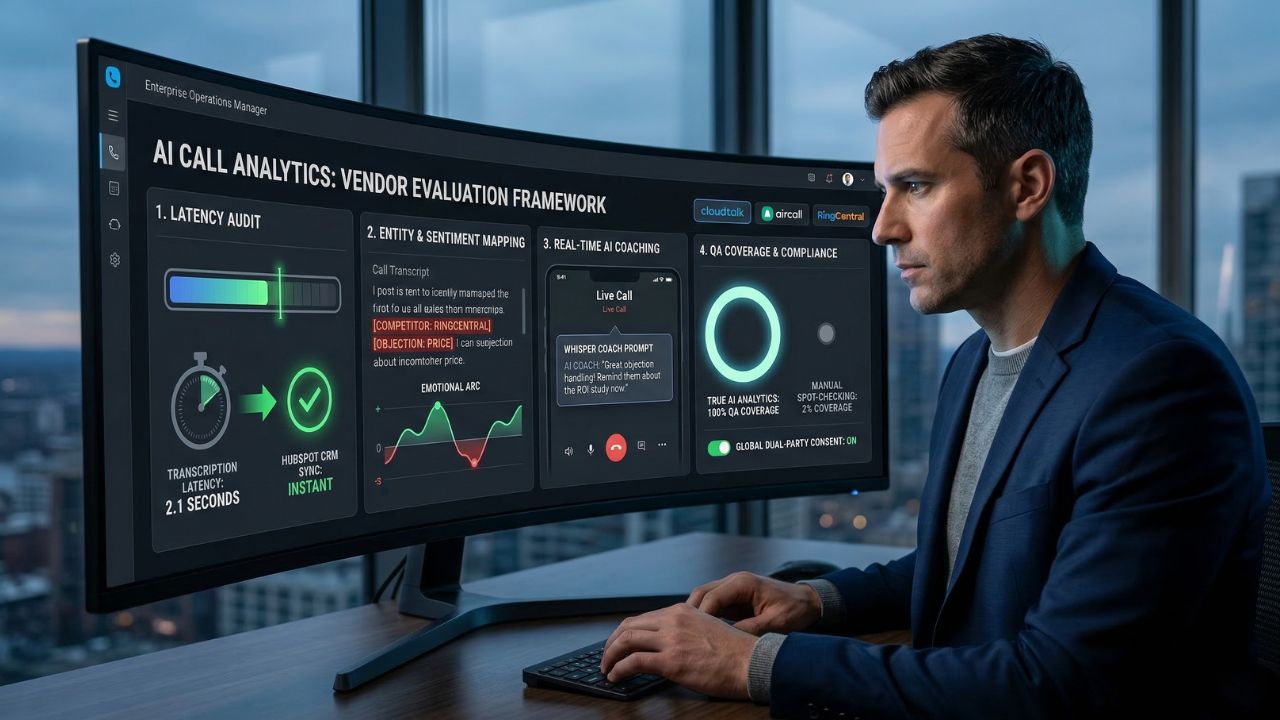
Step 1: Benchmark Transcription Latency
The foundation of all AI-powered call analytics features is the speech-to-text engine. If the transcription is inaccurate or slow, every downstream AI feature fails.
When auditing a platform, the critical metric is transcription latency. This measures the time it takes for the system to process the audio, generate the transcript, and push that text via API into your CRM (like Salesforce or HubSpot). If your reps must wait five minutes for the transcript to appear before they can log their notes, the AI has created a workflow bottleneck rather than removing one.
Top-tier systems achieve this sync in under 30 seconds post-call. During vendor evaluations, demand a live demonstration of this exact sync speed rather than relying on glossy marketing videos.
Step 2: Verify Entity Recognition for Objection Handling
Generating a wall of text is not actionable intelligence. The system must understand the context of the words. This relies on entity recognition.
When you evaluate the top CloudTalk alternatives, look at how the AI categorizes speech. Does it automatically flag when a prospect mentions a specific competitor? Does it highlight the exact timestamp where the prospect brings up budget constraints?
A robust engine tags these moments automatically, populating your CRM with structured data. A manager can then instantly pull a report showing every instance where a rep faced a pricing objection and exactly how they responded, eliminating the need to scrub through hours of audio manually.
Step 3: Audit Sentiment Mapping and Emotional Arc
Not all lost deals stem from a logical disagreement; many fail due to a breakdown in conversational rapport. This is where sentiment mapping becomes crucial.
Advanced AI models do not just transcribe words; they analyze the acoustic properties of the voice—pitch, cadence, and volume—combined with lexical choices to track the emotional arc of the call. If a prospect starts the call with a positive, engaged tone but shifts to a negative, closed-off posture at the 14-minute mark, the AI flags that exact moment.
This allows a manager to listen to the specific 30-second window that derailed the deal. Often, this reveals a rep interrupting the prospect or failing to practice active listening. Without sentiment mapping, finding these subtle behavioral flaws across thousands of calls is statistically impossible.

Step 4: Enforce Compliance and Dual-Party Consent
Recording and analyzing calls carries massive legal liability. If you operate in or dial into regions with strict privacy regulations, your AI stack must adapt dynamically.
When you compare 5 AI VoIP Traps: CloudTalk vs Aircall vs RingCentral, their approach to compliance is a major differentiator. The system must possess automated, geo-aware guardrails. If a rep dials an area code in a dual-party consent state, the VoIP system should automatically play a legally compliant recording notification before the audio bridges.
If your system requires the SDR to manually click a box or remember to read a script to trigger the recording, you are exposed to significant legal risk resulting from simple human error.
Real-Time Whisper Coaching: The 2026 Differentiator
Post-call analytics are excellent for weekly training, but they cannot save a call that is actively failing. The frontier of AI VoIP is real-time intervention.
Systems equipped with "whisper" capabilities listen to the live audio stream. If the prospect mentions a specific competitor, the AI instantly pushes a battlecard onto the SDR's screen outlining the counter-arguments. If the rep begins talking too fast or dominating the talk-time ratio, a visual cue prompts them to pause and ask a question.
However, running these models in real-time requires immense server-side processing. This is why investigating Aircall vs RingCentral AI limitsis critical for enterprise buyers. An underpowered system will lag, delivering the battlecard seconds after the conversation has already moved on.
Furthermore, when integrating these systems, beware of platforms with HubSpot, Aircall, and CloudTalk integration flaws. An AI tool that cannot sync its findings reliably back to your central source of truth creates data silos and destroys operational efficiency.
The Final Audit
Do not let slick user interfaces distract from architectural realities. Force vendors to demonstrate their transcription speeds, verify their entity recognition logic using your specific industry keywords, and mandate proof of automated compliance workflows. Your SDR quota attainment depends entirely on the technical rigor you apply during procurement.
Scale Securely with Proven Tools. Try Proton AI

We may earn a commission if you buy through this link. (This does not increase the price for you)
Frequently Asked Questions (FAQ)
AI-powered call analytics utilize advanced machine learning to transcend basic recording. They process audio into actionable intelligence, using entity recognition and sentiment mapping to automatically populate CRM deal stages and provide deep insights into customer conversations.
Speech sentiment analysis tracks the emotional arc of a conversation by analyzing voice tone and keyword context. It helps sales managers instantly identify exactly where reps are losing the prospect, providing critical data for targeted coaching.
The best AI reporting depends on your primary goal. Platforms excelling in this space push actionable intelligence instantly. CloudTalk dominates outbound AI reporting, while RingCentral provides robust multi-language transcription reporting designed for massive global enterprise requirements.
Yes. Modern AI-powered call center solutions can detect a customer's churn risk through highly accurate sentiment analysis. They monitor the emotional trajectory of the call to immediately flag at-risk accounts before they finalize their cancellation.
Evaluate software using a strict technical framework. You must audit transcription latency times, verify entity recognition for objection keywords, stress-test sentiment mapping accuracy, and ensure strict legal guardrails are in place for dual-party consent.
Absolutely. Native AI coaching provides real-time prompts and "whisper" coaching to reps during live calls based on sentiment analysis. This immediate feedback helps them pivot in real-time, ultimately identifying top-performer patterns and replicating them instantly.
Beyond standard connection rates, you must track transcription latency (seconds until CRM sync) and QA coverage percentages. Modern AI centers should analyze 100% of interactions, completely replacing the outdated model of listening to only 2% of calls.
Yes, but compliance varies strictly by vendor configuration. Enterprise platforms must enforce legal guardrails, including automated "dual-party consent" notifications that dynamically adapt based on the caller's physical geography, to ensure AI recordings remain fully legally compliant.
Implementing true AI features usually incurs premium subscription fees. Hidden costs often include premium support tiers for faster response times, API integration maintenance, and additional charges for highly advanced tools like real-time coaching or high-accuracy transcription.
Yes, but seamless integration is rare. Many teams find their system fails to sync data correctly, leading to delayed transcript logging. You must verify API access and ensure the AI overlay communicates perfectly with your existing routing logic.