Best AI CRM Tools for Solopreneurs: Salesforce vs. HubSpot AI
When you are a one-person business, you don't just need a place to store phone numbers. You need a digital sales partner.
In the past, Customer Relationship Management (CRM) software was just a glorified address book. Today, customer relationship management software with artificial intelligence has changed the game. Modern AI CRMs can automatically find leads, write emails for you, and tell you exactly which prospect is ready to buy right now.
But for the solopreneur, the choice often comes down to the two giants: Salesforce and HubSpot. This guide breaks down the Salesforce vs HubSpot AI features comparison to help you decide which best CRM software for one-person business will help you scale without hiring a sales team.
Explore the AI Solopreneur Hub
- The AI Solopreneur: Guide to One-Person Enterprise
- Top 10 AI Agents That Replace Marketing Agencies in 2026
- AI Chatbots vs. Virtual Assistants: The Support Battle
- AI Bookkeeping: Automate Your Business Taxes
- Best Business Credit Cards for AI Startups
- Using Predictive AI for Stock Market Analysis
- Cybersecurity for Solopreneurs: Protecting Data from Deepfakes
- Cloud Hosting for AI: GPU vs. CPU Servers
- Do You Need Business Insurance for an AI Agency?
- How to Build a $10k/Month Business with $0 Upfront Cost
- Case Study: I Let AI Run My Dropshipping Store for 30 Days
- The Death of 9-5: Agentic AI & The Solopreneur Boom
The Solopreneur Dilemma: Power vs. Simplicity
Before we look at the features, we need to look at the philosophy.
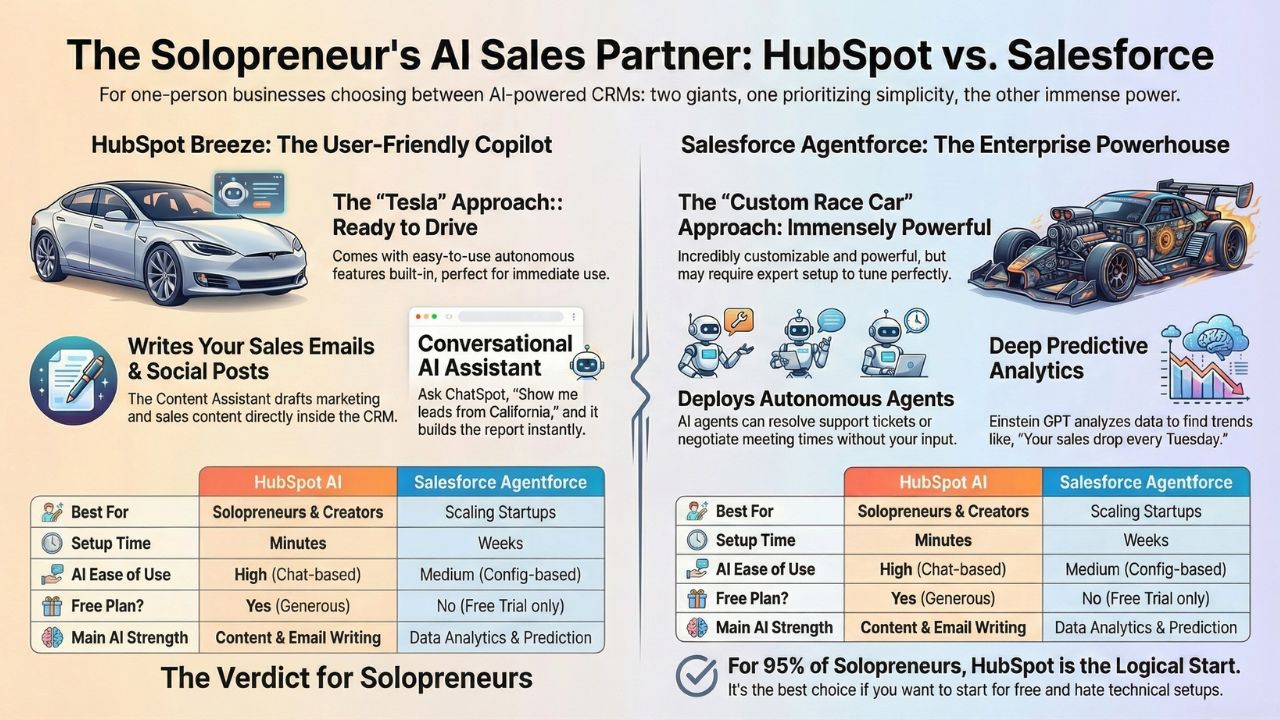
- Salesforce is like a custom-built race car. It is incredibly powerful and customizable, but you might need a mechanic (or a developer) to tune it perfectly.
- HubSpot is like a Tesla. It comes ready to drive, looks great, and has autonomous features built-in that are easy to use right away.
For a solopreneur, the "best" tool is the one you will actually use. Complex setups are the enemy of speed.
Feature Showdown: The AI Agents
Both platforms have launched aggressive AI tools in 2025. Here is how they stack up for the solo founder.
1. HubSpot Breeze (The User-Friendly Copilot)
HubSpot’s new AI engine, "Breeze," is designed specifically for ease of use. It lives inside your browser and helps you execute tasks without leaving the page.
- Content Assistant: It drafts sales emails, blog posts, and social captions directly inside the CRM. You don't need to switch to ChatGPT.
- ChatSpot: This is a conversational bot. You can text it, "Show me all leads from California who haven't replied in 3 days," and it will build the report for you instantly.
- Predictive Lead Scoring: HubSpot uses automated lead scoring tools reviews data to rank your contacts. It tells you, "Call John Doe first, he is 80% likely to buy."
Verdict: Best for solopreneurs who want to "plug and play."
2. Salesforce Agentforce (The Enterprise Powerhouse)
Salesforce has rebranded its AI efforts under "Agentforce." This is a heavy-duty engine built for creating autonomous agents that can handle complex jobs.
- Autonomous Agents: unlike simple chatbots, these agents can resolve customer support tickets or negotiate meeting times without you ever touching the keyboard.
- Einstein GPT: This offers deep analytics. If you have thousands of leads, Einstein can analyze trends and tell you, "Your sales drop every Tuesday, try sending emails on Wednesday morning instead."
- Deep Customization: You can build custom AI actions. For example, "When a VIP client visits my pricing page, alert me via SMS immediately."
Verdict: Best for solopreneurs with high transaction volume or complex sales cycles.
The Cost of Implementation for Small Business
This is where the battle is often won or lost for the affordable CRM for startups.
HubSpot Pricing
- Entry: They offer a robust Free Tier that is perfect for starting out.
- Growth: The "Starter" suite begins around $15-$20/month.
- Hidden Costs: Minimal. You can set it up yourself in an afternoon.
Salesforce Pricing
- Entry: The "Starter" edition (formerly Essentials) costs around $25/month.
- Growth: Prices jump quickly as you add features like API access or advanced automation.
- Hidden Costs: High. The CRM implementation cost for small business can be steep because Salesforce often requires a consultant to set up correctly if you want to use its full power.
Which One Wins for the "Zero-Employee" Enterprise?
If your goal is to build a Zero-Employee Enterprise, efficiency is your most valuable asset.
Choose HubSpot AI if:
- You want to start for free today.
- You hate technical setup and coding.
- You need marketing features (email newsletters, landing pages) built into your CRM.
- Top rated sales automation platforms 2025 reviews consistently rank it higher for "Ease of Use."
Choose Salesforce Agentforce if:
- You plan to scale to 50+ employees quickly.
- You need highly specific, custom workflows (e.g., for a niche manufacturing business).
- You are already using other Salesforce products (like Slack or Tableau).
Quick Comparison Table
| Feature | HubSpot AI | Salesforce Agentforce |
|---|---|---|
| Best For | Solopreneurs & Creators | Scaling Startups & Enterprise |
| Setup Time | Minutes | Weeks |
| AI Ease of Use | High (Chat-based) | Medium (Config-based) |
| Free Plan? | Yes (Generous) | No (Free Trial only) |
| Main AI Strength | Content & Email Writing | Data Analytics & Prediction |
Final Verdict
For 95% of solopreneurs reading this, HubSpot is the logical starting point. It respects your time and doesn't require an engineering degree to operate. However, if you are building a complex B2B tech startup, Salesforce offers a ceiling you will never hit.
The "best" CRM isn't the one with the most features; it's the one that helps you close deals while you sleep.
Frequently Asked Questions (FAQ)
Yes. Your brain cannot track 50 active leads, follow-ups, and deal stages. A CRM frees up your mental RAM so you can focus on high-level strategy, not remembering who to email.
Yes. Tools like Zoho CRM and Pipedrive are affordable CRM for startups. However, they currently lag behind in the advanced AI features that HubSpot and Salesforce offer.
You can, but it is painful. Moving data is messy. It is better to pick a platform that can grow with you from day one.
Sources and References
Software Verification:
Market Data & Trends: