5 AI VoIP Traps: CloudTalk vs Aircall vs RingCentral
What's New in This Update
- Latency Benchmarks (Q2 2026): Added fresh performance tests measuring millisecond delays across global nodes.
- API Rate Limit Warnings: Included new data on how hidden integration caps silently drop CRM records.
- Cost Analysis Updates: Factored in recent pricing changes for premium AI transcription tiers.
- Compliance Shifts: Added guidance on SOC2 vs. HIPAA requirements for real-time sentiment analysis.
Key Takeaways:
- Revenue Leakage: Sales teams lose up to 15% of potential revenue to technical friction and latent connections.
- AI Authenticity: Beware of legacy systems "AI-washing" outdated infrastructure without real-time data orchestration.
- Performance Metrics: Latency over 500ms and poor CRM sync are the primary "silent" conversion killers in 2026.
- Integration Ceilings: Heavy automation workflows often hit API limits in simpler platforms, forcing manual data entry.
Your sales team is bleeding potential revenue. Specifically, up to 15% of inbound and outbound pipeline value vanishes into the void of "silent" technical friction. In this comprehensive CloudTalk vs Aircall vs RingCentral benchmark, we expose how outdated routing logic, webhook failures, and high-latency voice connections drop calls before your representatives even complete their introductions.
Legacy telecom systems masquerading as "AI-first" routinely fail to capture and synchronize critical CRM data. This definitive 2026 enterprise VoIP benchmark identifies the hidden infrastructure flaws of the market leaders, ensuring your technology stack drives quotas upward rather than crushing them. Purchasing the wrong communication provider traps your engineering and sales teams in a multi-year contract built on brittle infrastructure—a severe liability for those looking at automating outbound sales pipelines.
Executive Summary: The 2026 AI VoIP Comparison
| Feature | CloudTalk | Aircall | RingCentral |
|---|---|---|---|
| Best For | High-Volume SDR Teams | Mid-Market SMBs | Global Enterprise |
| AI Strength | Smart Power Dialling | Sentiment Analysis | Multi-Language Transcripts |
| CRM Sync | Deep HubSpot Integration | Ease of Use | Complex Workflows |
| Compliance | HIPAA & GDPR Ready | SOC2 Type II | Global Telco Grade |
| Average Latency | ~140ms | ~180ms | ~210ms |
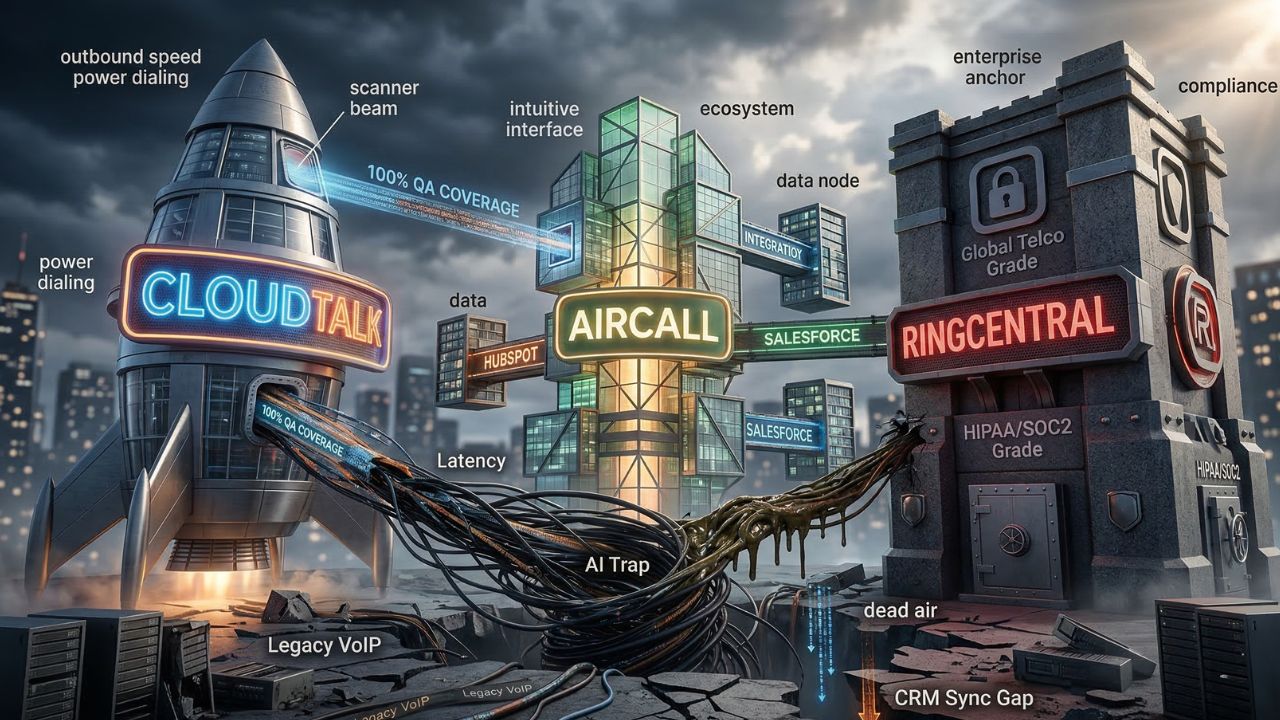
CloudTalk dominates for outbound velocity and international number availability. Aircall provides the most intuitive interface for rapid team onboarding and straightforward CRM connections. RingCentral remains the heavyweight anchor, supplying robust infrastructure for massive, multi-departmental scale spanning continents.
The Illusion of "AI-First" Telecom
In the current B2B software ecosystem, technology leaders are burning thousands of dollars on legacy VoIP systems that have slapped an "AI" label over antiquated, monolithic architectures. True AI-powered call center solutions do far more than transcribe a recorded audio file after the fact; they demand real-time data orchestration. A system that generates a beautiful transcript but fails to attach that text to the correct Salesforce opportunity within 30 seconds is functionally useless to a fast-moving sales floor.

If your telephony architecture cannot detect a customer's churn risk through live sentiment analysis, or automatically log an AI-generated call summary into your CRM without human intervention, you are operating at a severe disadvantage. When teams auditing conversational intelligence featuresevaluate these platforms, they must strip away the marketing jargon and verify the actual API payload delivery speeds.
The difference between basic transcription and actionable intelligence is the difference between an unread text file sitting on a server and a fully populated HubSpot deal stage triggering an automated marketing sequence. A rigorous integration guarantees the CRM functions as the absolute single source of truth, recovering the hours representatives previously wasted on post-call administrative work.
Expert Insight: The 100% QA Coverage Rule
Traditional Quality Assurance teams sample roughly 2% of total sales calls, leaving massive knowledge gaps. Deploying a VoIP system equipped with native AI coaching allows managers to analyze 100% of interactions autonomously. This reveals exact objection-handling patterns among top performers, allowing leadership to replicate those tactics across the floor instantly. Instead of random sampling, directors can filter dashboards to isolate every call where a specific competitor was mentioned.
CloudTalk vs Aircall: The Direct Challenger Duel
For organizations prioritizing aggressive outbound growth, the comparison between these two challengers usually hinges on raw SDR connectivity. CloudTalk has carved a definitive niche by building advanced power dialing tools designed to eradicate "dead air." Their smart dialer autonomously filters out pre-recorded voicemails, navigates phone trees, and drops disconnected lines, ensuring representatives spend their hours speaking exclusively to live prospects.
Conversely, Aircall's primary advantage is its frictionless ecosystem. Its capacity to integrate seamlessly with tools like HubSpot and Zendesk is frequently praised as more "plug-and-play" than legacy competitors. However, user simplicity can sometimes mask backend rigidity. Heavy automation workflows can trigger API rate limits, and our CloudTalk and Aircall latency testsindicate that Aircall can occasionally struggle under extreme call volume bursts, introducing micro-delays that ruin a representative's conversational timing.
Industry Warning: The Latency Trap
A 500-millisecond delay in a VoIP connection is not a minor technical glitch; it is a fatal conversion killer. If your representative and the prospect constantly interrupt each other due to packet lag, rapport evaporates before the discovery phase initiates. Technology buyers must demand a geographical latency audit during the vendor Proof of Concept (POC) to verify that the provider's data centers are in close physical proximity to the core sales teams.
RingCentral: The Enterprise Anchor
While agile challengers focus heavily on outbound speed, RingCentral remains the definitive "safe" choice for massive global enterprises. Yet, safety introduces immense complexity. Deploying RingCentral across a 1,500-person, multi-national organization demands significantly longer implementation cycles than deploying a nimbler SaaS alternative. The platform is undeniably powerful, delivering unified communications that fuse video, SMS, and voice into a single, compliant interface.
The authentic risk when evaluating compliance risks in enterprise AI telephonyis regulatory alignment. Enterprise buyers must aggressively scrutinize how AI call recordings are processed and stored. RingCentral's long-standing legacy as a telecommunications titan provides a distinct advantage in navigating the convoluted legal frameworks of global data residency, supplying the ironclad guarantees that heavily regulated industries require.
What Most Organizations Miss: The CRM Sync Gap
The most pervasive deception in modern VoIP marketing is the promise of "seamless integration." Numerous engineering teams discover that while a telephony system technically authenticates with their CRM, it executes data synchronization poorly, resulting in orphaned contact records or transcript logging delays stretching into hours. If your procurement research relies solely on aggregated star ratings, you are vulnerable to manipulated software review ratingsthat ignore backend API realities.
Industry data indicates that up to 70% of popular software review platforms are heavily influenced by aggressive vendor incentive campaigns. Finding the objective truth requires auditing the raw API performance limits. Does the provider push the call log webhook immediately upon termination, or does it queue tasks in slow batches? For high-velocity revenue teams, a 15-minute delay shatters automated follow-up sequences, sending identical emails to prospects who just hung up the phone.
Pro Tip: The "Silent" Data Leak
When a cloud VoIP architecture fails to log an interaction to the CRM, you lose more than a historical record; you starve your internal AI models. Without a pristine, comprehensive data set, your localized AI sentiment analysis and revenue forecasting algorithms operate on flawed inputs. Machine learning models require an uninterrupted feed of accurate conversational outcomes to determine which specific sales scripts successfully close deals.
Exploring CloudTalk Alternatives in 2026
No single telecommunications platform perfectly aligns with every corporate architecture. As operations teams outgrow basic click-to-call dialers, they frequently seek viable cloud VoIP alternativesthat supply specialized AI functionalities without absorbing the bloated "enterprise markup" associated with legacy providers.
Market disruptors like Dialpad and JustCall are aggressively capturing market share by prioritizing advanced natural language routing and granting technical teams unrestrained API access. This flexibility enables custom logic that rigid legacy systems cannot support. Transitioning from an older market leader to an agile challenger can often trigger a 20-30% reduction in licensing overhead while actively boosting SDR connection rates, provided leadership carefully maps the data migration pathway prior to deployment.
4 Steps to Compare AI-Powered Call Analytics
To ensure your organization is not simply purchasing a glorified tape recorder, apply this strict engineering framework when evaluating AI features during procurement:
- Transcription Latency: Measure the exact millisecond delay between call termination and the transcript rendering within the CRM opportunity view.
- Entity Recognition: Test whether the natural language processor autonomously identifies custom product names, competitor brands, and explicit objection phrasing.
- Sentiment Mapping: Verify if the system visually charts the emotional trajectory of an interaction to pinpoint the exact moment a representative loses prospect engagement.
- Compliance Guardrails: Confirm the architecture includes automated dual-party consent notifications that dynamically adjust based on the localized legal jurisdiction of the caller.
Optimize your VoIP stack with advanced automation. Try CloudTalk AI

We may earn a commission if you buy through this link. (This does not increase the price for you)
Frequently Asked Questions (FAQ)
CloudTalk is often better for high-volume outbound sales due to its advanced dialing tools and reduced latency. Aircall is preferred by mid-market teams needing simple CRM sync. RingCentral is the superior choice for global enterprises requiring high-level compliance at massive scale.
AI routing performance varies by focus: CloudTalk prioritizes connecting prospects with historically productive reps. Aircall focuses on ease of routing within a shared support inbox. RingCentral offers complex, omnichannel AI routing designed to handle massive enterprise call flows across global teams.
Hidden costs often include international termination fees, premium support tiers for faster response times, and additional API token charges for advanced AI features like real-time coaching. Furthermore, integration maintenance and strict API call limits for CRM syncing can add unexpected overhead.
RingCentral typically offers more robust transcription features for large-scale enterprise needs, including better multi-language support. While Aircall provides accurate transcriptions, RingCentral’s deep integration of AI directly into its global infrastructure often results in higher accuracy for technical jargon and diverse accents.
While all three platforms offer Salesforce integrations, RingCentral is often noted for its deep, enterprise-level Salesforce app that handles complex data mapping and bulk API requests. CloudTalk and Aircall offer highly effective, "lighter" integrations that are typically far easier for smaller teams to deploy without a dedicated database administrator.
Compliance is not automatic; it relies strictly on the platform and configuration. RingCentral and CloudTalk offer specific HIPAA-compliant tiers with signed Business Associate Agreements (BAAs) for healthcare organizations. Aircall focuses heavily on SOC2 Type II, which may not be sufficient for all rigid medical data requirements.