How FinTechs Use Python to Predict Battery Life
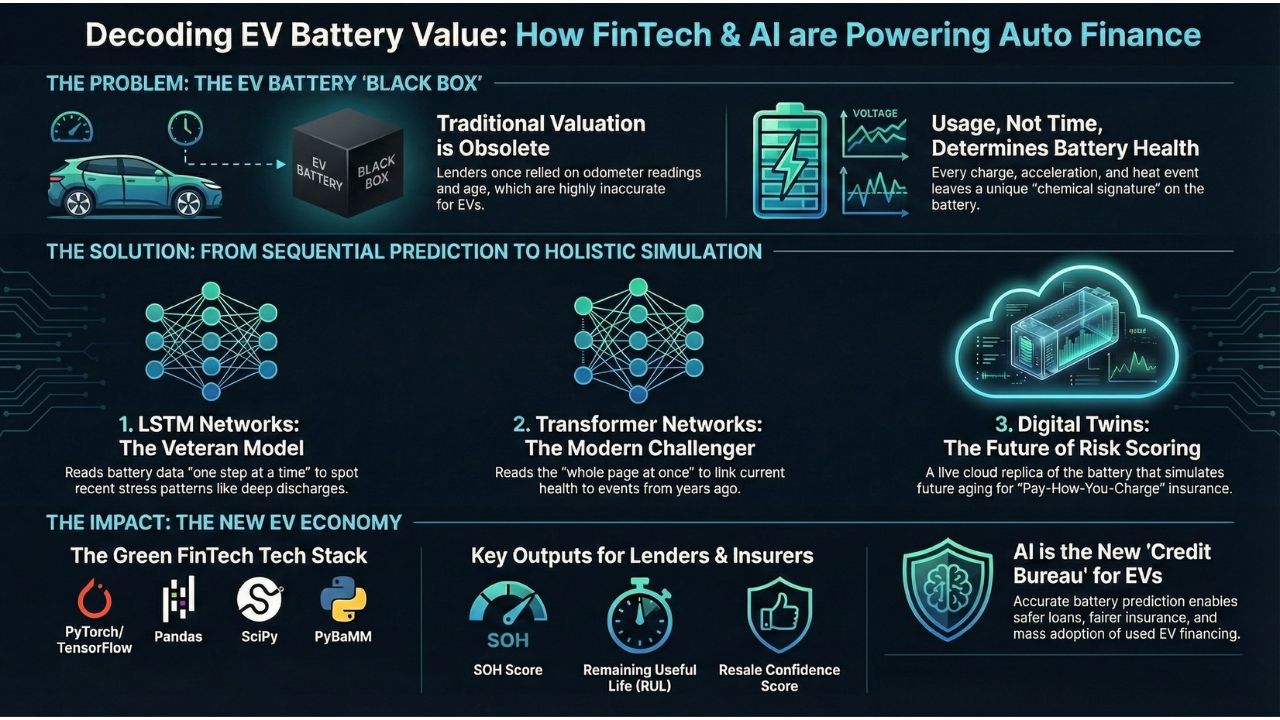
The "Black Box" of EV finance is finally opening. For years, lenders and insurers treated electric vehicle batteries like mystery boxes.
They relied on simple heuristics, odometer readings and manufacturing dates, to guess a car's value. That era is over.
Today, the most sophisticated fintech developers aren't just looking at spreadsheets; they are looking at Green fintech developers' code.
They are deploying advanced Machine learning in finance architectures to perform granular EV battery analytics.
This "Developer Deep Dive" moves beyond the buzzwords. We are tearing down the actual Machine learning architectures for battery life to see how Fintech AI turns raw voltage data into a "Resale Confidence Score."
Related Deep Dives on AI & EV Finance
The Challenge: Why Battery Data is Hard to Read
Predicting the State of Health (SOH) of a lithium-ion battery is a classic Time-series forecasting problem, but with a twist.
A battery doesn't just age with time; it ages with usage.
Every acceleration, every fast charge, and every hot afternoon creates a unique chemical footprint.
To predict the Remaining Useful Life (RUL), an algorithm must analyze terabytes of sequential charging data.
Two deep learning heavyweights are fighting for dominance in this space: Recurrent Neural Networks (RNNs) (specifically LSTMs) and Transformer models.
1. The Veteran: Long Short-Term Memory (LSTM) Networks
For a long time, the LSTM model for battery life was the industry standard. Why? Because battery data is sequential.
How it works: Imagine reading a book one word at a time, remembering the context of the previous sentence to understand the current one.
That is an LSTM. It processes data step-by-step.
The "Memory" Gate: LSTMs have a unique "gating" mechanism that decides what to remember and what to forget.
For RNN for time-series charging data, this is crucial. It can "remember" that a user frequently drains their battery to 0% (a bad habit) and carry that context forward to predict future degradation.
Why Developers Use It: LSTMs are computationally efficient for shorter sequences.
If you want to detect immediate Battery stress markers thermal runaway based on the last 50 charging cycles, LSTMs are incredibly fast and effective.
The Code Concept (PyTorch style):
Python
# Conceptual LSTM Block for Battery Data
class BatteryLSTM(nn.Module):
    def __init__(self, input_size, hidden_size):
        super(BatteryLSTM, self).__init__()
        # Captures sequential dependencies in voltage/current data
        self.lstm = nn.LSTM(input_size, hidden_size, batch_first=True)
        self.linear = nn.Linear(hidden_size, 1) # Outputs SOH Score

    def forward(self, x):
        out, _ = self.lstm(x)
        return self.linear(out[:, -1, :])
2. The Challenger: Transformer Networks
While LSTMs read the book word-by-word, Transformer networks for time-series financial data read the whole page at once.
The "Attention" Mechanism: Instead of processing data in order, Transformers use "Self-Attention" mechanisms (Query, Key, Value vectors).
This allows the model to weigh the importance of every data point against every other data point simultaneously.
The Advantage: This is a game-changer for Long-tail keywords: LSTM vs Transformer for battery prediction.
A Transformer can spot a correlation between a thermal event 3 years ago and a voltage drop today, a "long-range dependency" that an LSTM might forget.
Why it Matters for Fintech: For Calculating EV residual value using AI, you need the lifetime context of the vehicle.
Transformers provide a more accurate long-term RUL prediction lithium ion battery by analyzing the entire history of the asset in parallel.
3. Digital Twins: The "Pay-How-You-Charge" Engine
The most exciting application of this code is the creation of a Digital twin for EV battery.
A Digital Twin is a virtual replica of a physical battery, living in the cloud.
It is fed real-time data from the vehicle's Battery Management System (BMS).
How Insurance Companies Use It: Insurers are no longer guessing risk.
They are running simulations on these twins to calculate Digital twins for EV insurance premiums.
- Ingestion: The BMS data analysis Python script pipes voltage, current, and temperature data to the cloud.
- Simulation: The Digital Twin (powered by Deep learning for batteries) simulates how the battery will behave under future stress.
- Risk Scoring: The model detects anomalies like Battery voltage deviation analysis or cell imbalance.
- Premium Calculation: If the Digital Twin shows a high "Health Score" (meaning the owner charges responsibly), the algorithm automatically lowers the insurance premium.
This is Algorithmic finance in action.
Conclusion: The Code Behind the Cash
For Green fintech developers, the mission is clear. It is not just about writing code; it is about rewriting value.
By mastering Battery health prediction using machine learning, you aren't just predicting voltage drops, you are predicting the financial future of an asset.
Whether you choose the sequential precision of LSTMs or the global attention of Transformers, your algorithms are the new credit bureaus of the net-zero economy.

Frequently Asked Questions (FAQ)
While LSTMs are excellent for sequential data, they can struggle with "forgetting" information over very long sequences. Transformer models use an "Attention Mechanism" that allows the algorithm to look at the entire history of the battery's life simultaneously. This makes them more effective at identifying long-range dependencies, such as how a thermal event three years ago might be causing voltage instability today.
For building LSTMs and Transformers, PyTorch and TensorFlow (Keras) are the industry standards due to their robust support for deep learning architectures. For data preprocessing (handling the time-series voltage/current logs), Pandas and SciPy are essential. For specific battery analytics, libraries like PyBaMM (Python Battery Mathematical Modelling) are gaining popularity among green fintech developers.
A "State of Health" (SOH) score is a metric (usually a percentage) representing the battery's current condition compared to when it was new. A "Digital Twin" is a complex, virtual simulation of the battery living in the cloud. It doesn't just give a score; it simulates how the battery will behave under future conditions, allowing insurers to predict risk dynamically.
Lenders and insurers rely on "Backtesting." They run the AI model on historical data where the outcome is already known to see if the model's predictions match reality. Additionally, compliance with standards like the NITI Aayog Battery Swapping Policy ensures that the data structure (BMS data) is standardized and trustworthy.