Autonomous Gaming Agents 2026: Why Legal Farm-Bots Killed the Grind
By Sanjay Saini | Last Updated: 13-May-2026

What's New in This Update
- Added technical architecture breakdown separating API-level Copilots from legacy macro scripts.
- Expanded the core use cases to include guild management and build optimization.
- Updated economic impact sections reflecting 2026 resource depreciation mechanics.
- Included hardware implications for edge AI agent deployment.
TL;DR: The End of the Grind
- The Shift: Game developers are now officially integrating and monetizing AI agents to perform repetitive PVE tasks, replacing illegal third-party botting.
- The Motivation: Adult gamers have disposable income but limited time. Authorized AI agents improve player retention by bridging the gap between casual and hardcore players.
- The Tech: Unlike old memory-injection hacks, 2026 gaming agents use native APIs and Copilot integrations to parse complex game states safely.
- The Guardrails: To prevent hyper-inflation, studios are deploying "Human-Only Zones" and localized AI processing limits.
"Grinding" is So 2023.
We have all been there. You want to reach Level 50 to wear that cool armor, but you have to kill 5,000 boars to get there.
It’s boring. It’s repetitive. It’s work. In the past, if you used a "bot" to do this for you, you faced the swift and unforgiving ban-hammer of the game's anti-cheat engine.
In 2026, the paradigm has completely flipped. The game developers no longer want to ban you; they want you to use their built-in bots. We are witnessing the meteoric rise of Autonomous Gaming Agents—official, authorized AI assistants that play the tedious parts of the game for you, so you can focus entirely on the fun.
This is the death of the grind, and it changes the fundamental economics of gaming forever.
Explore AI Gaming 2026 Hub
- AI Gaming World: Infinite Play & Generative Worlds
- Can Your NPU Run GTA 6? The Reality of Local AI Gaming
- Nvidia ACE vs. AMD Ryzen AI: Who Wins the Battle for Smart NPCs?
- Best AI Gaming Laptops 2026: Benchmarked & Ranked
- Cloud Gaming vs. Edge AI: Do You Need an RTX 5090?
- Top 10 Games with Sentient AI NPCs You Can Talk To (2026 Edition)
- Roblox vs. Fortnite Creative: Which AI Map Generator is Better?
- VR + AI: Creating 'Holodeck' Experiences in Your Living Room
- Stop Playing, Start Building: Create a 3D RPG with Zero Code
- How to Use Midjourney & Sora to Create Game Assets
- Monetizing AI Mods: Sell Generative Levels & Skins
What are "Authorized" AI Agents?
Unlike the illegal "aimbots" of the past that ruined competitive shooters by hooking directly into a client's memory address space, autonomous gaming agents in 2026 are designed purely for PVE (Player vs. Environment) tasks and run on sanctioned API rails.
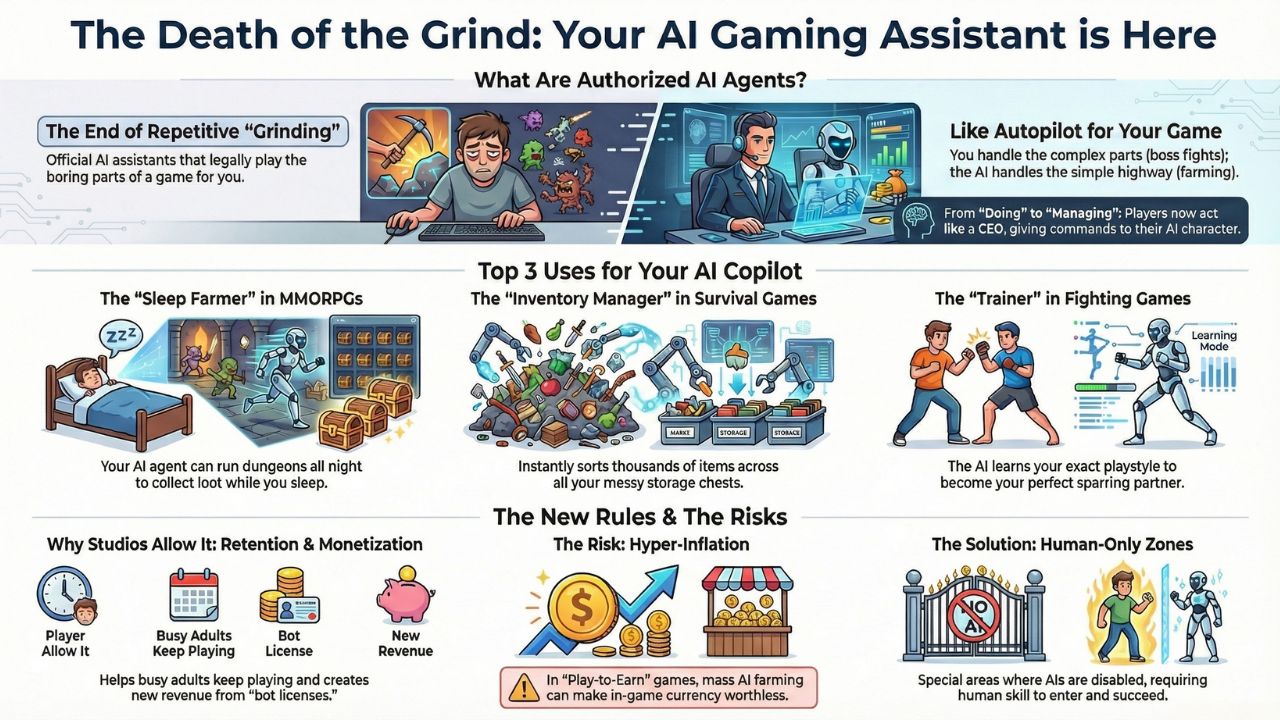
Think of it like the "Autopilot" on a Tesla. The human and the machine operate in a hybrid orchestration model:
- You drive the car on the tricky city streets (The complex raid mechanics, the social interactions, the PVP).
- The AI drives the car on the long, boring highway (Resource Farming, fetching water, organizing bank tabs, leveling alts).
Major studios are now integrating tools like Microsoft Copilot gaming features directly into the game's UI. You no longer have to risk downloading shady Python scripts from a sketchy forum. Instead, you can press a button, give a natural language prompt like "Go fish for Salmon in the Northern River until my bags are full," walk away to make a sandwich, and your character executes the task flawlessly.
This hybrid experience allows players to engage with the dynamic elements of the world, like sentient AI NPCs you can talk to, without getting bogged down by the game's necessary economic friction.
The Legal Shift: Why Studios Are Saying "Yes"
For twenty years, MMO developers fought a relentless, expensive war against botters. Why the sudden architectural and philosophical change?
- Player Retention Mechanics: The core demographic of MMO gamers has aged. Adults have mortgages and 40-hour workweeks. They physically cannot play 8 hours a day to keep up with server progression. If the grind is too hard, they cancel their subscriptions. AI agents for video game grinding allow casual players to maintain parity with hardcore gamers, keeping the server populations healthy.
- Monetization of Convenience: The game companies realized they were leaving money on the table. Instead of players buying "Gold" from a shady third-party website—which damages the game's integrity—they now buy a "Farm Bot License" or "Copilot Tokens" directly from the game's official store for $10 to $15 a month.
- The "Manager" Era of Gaming: The very definition of gameplay is shifting from "doing every action" to "managing a portfolio of assets." You are becoming the CEO of your character roster. You dictate the strategy, and the agentic system figures out the execution path.
Top 5 Uses for Your AI Copilot in 2026
1. The "Sleep Farmer" (MMORPGs)
In massive environments like World of Warcraft (with the new "Helper" addons officially sanctioned by Blizzard) or Black Desert Online, you can set up a "Macro-Agent." You go to sleep at 11 PM. Your agent wakes up, pathfinds to a specific dungeon loop, runs it for 6 hours, collects loot, travels back to town to repair your gear, and logs off before your alarm goes off.
The Result: You wake up rich and ready to spend your session doing the content you actually enjoy.
2. The "Inventory Manager" (Survival Games)
In games like Minecraft, Rust, or Escape from Tarkov, organizing chests and stash tabs is a notoriously frustrating mini-game in itself. New AI copilot for gaming tools can ingest the visual state of your 50 messy chests and instantly sort everything using spatial reasoning algorithms: Wood in Box A, Stone in Box B, Rare Weapons in Box C. It executes this in milliseconds.
3. The "Ghost Trainer" (Fighting & Strategy Games)
Want to get better at Street Fighter 7 or League of Legends PVP? You can train against a "Ghost" of yourself. The AI ingests your match history, learns your exact playstyle, and fights you. It exposes your predictable patterns and weaknesses, offering a feedback loop far superior to getting destroyed in ranked matchmaking.
4. The "Build Optimizer" (ARPGs)
In complex Action RPGs like Path of Exile, calculating the math behind passive skill trees and gear synergies requires a spreadsheet. Agentic AI can now parse your current inventory, analyze the meta, and automatically equip or suggest the mathematically superior loadout for the specific boss you are about to fight.
5. The "Guild Quartermaster" (Social Gaming)
Running a massive guild requires intense logistics. AI agents now act as automated quartermasters, tracking guild bank contributions, automatically distributing raid consumables to authorized members, and flagging resource deficits before the big weekend events.
The Hardware Requirement: The Edge AI Factor
Running these complex agentic behaviors requires compute power. While some studios run the agent logic entirely server-side, many are offloading the processing to the player's machine to save on cloud costs. This is where on-device processing becomes critical.
To run local visual-parsing agents without dropping your frame rate, players are leaning heavily on machines powered by dedicated Neural Processing Units (NPUs). This hardware shift is essential; executing an AI agent locally requires the specialized silicon found in modern AI gaming laptops, rather than relying on standard CPU cycles.
This localized processing model directly competes with features built into Nvidia ACE and AMD Ryzen AI, marking a massive pivot away from cloud gaming vs edge AIstreaming toward heavy, localized intelligence.
The Dark Side: Play-to-Earn AI Automation and Economy Crashes
This technology has exploded with controversial results in the Web3, Crypto, and NFT gaming spaces. In play-to-earn AI automation, players are running "bot farms"—armies of AI agents to farm digital currency 24/7. When the currency translates directly to real-world fiat, the stakes are astronomical.
The Problem: If everyone has a robot farming gold, the supply of gold becomes infinite, and its value crashes to zero. This "Hyper-Inflation" destroys the game's economy.
The Solution: Developers are combating this through aggressive architectural changes:
- Human-Only Zones: Special raids or PVP arenas where API access is completely disabled, and server-side checks verify human-like input latency.
- Resource Depreciation: The more an agent farms a specific node, the less yield it produces, forcing the agent (and the player) to constantly seek new activities.
- Biometric Checkpoints: To enter high-value economic zones, players must prove they are human, often using complex generative puzzles that an AI agent cannot easily parse.
Beyond farming, players are also leveraging these tools for creation. From generating custom dialogue trees to monetizing AI mods, the line between player and developer is blurring entirely.
Frequently Asked Questions (FAQ)
If you use official tools (like Microsoft Copilot integration or in-game "Auto-Battle" features), No. If you use third-party scripts (like Python bots downloaded from GitHub) that the developer hasn't approved, Yes, you can still be banned. Always check the game's EULA regarding API usage.
It depends on what you enjoy. If you love the sense of accomplishment from doing everything by hand, don't use them. But for millions of players who just want to raid with their friends on the weekend without spending 20 hours gathering potions, these tools are a lifesaver.
Generally, No. Most competitive games (Call of Duty, Valorant, League of Legends) strictly ban AI assistance in matches against other players. These tools are almost exclusively designed for "Grinding", PVE environments, and "Single Player" content.
It depends on the architecture. Many official Copilots rely on cloud APIs directly integrated into the game server, requiring zero extra processing power. However, localized agents processing screen data in real-time benefit heavily from on-device Neural Processing Units (NPUs).
In unmanaged environments, it causes massive hyper-inflation of base resources (like ore or herbs). Developers combat this by capping agent daily hours, introducing human-only zones, or utilizing resource depreciation mechanics.
As we push deeper into the decade, Roblox generative environmentsand automated resource gathering will simply become the baseline expectation for any major online title. The grind is dead; long live the manager.