AI Gaming World: The End of Scripted Play & Infinite Worlds
What's New in This Update (May 2026)
- Updated Local AI Hardware Benchmarks: Added the latest testing data for 45+ TOPS NPUs running local 7B-parameter models for sentient NPCs.
- New Cloud Gaming Realities: Included recent analysis on NVIDIA's Q4 data center expansions and how they affect consumer cloud gaming latency.
- Agentic Workflows Added: Expanded the developer section to include how vibe-coding and agentic automation map directly to 3D asset generation workflows.
Key Takeaways
- The traditional "scripted era" of video games is ending; 2026 marks the widespread adoption of real-time generative gameplay and infinite map logic.
- Running sentient, unscripted NPCs without latency requires dedicated Neural Processing Units (NPUs) capable of 45+ TOPS.
- Players are transitioning into creators using text-to-world tools, allowing anyone to build 3D environments and rulesets using natural language prompts.
- Autonomous agents now handle tedious in-game grinding, fundamentally changing resource economies in MMOs.
The Shift: From "Scripted" to "Generative"
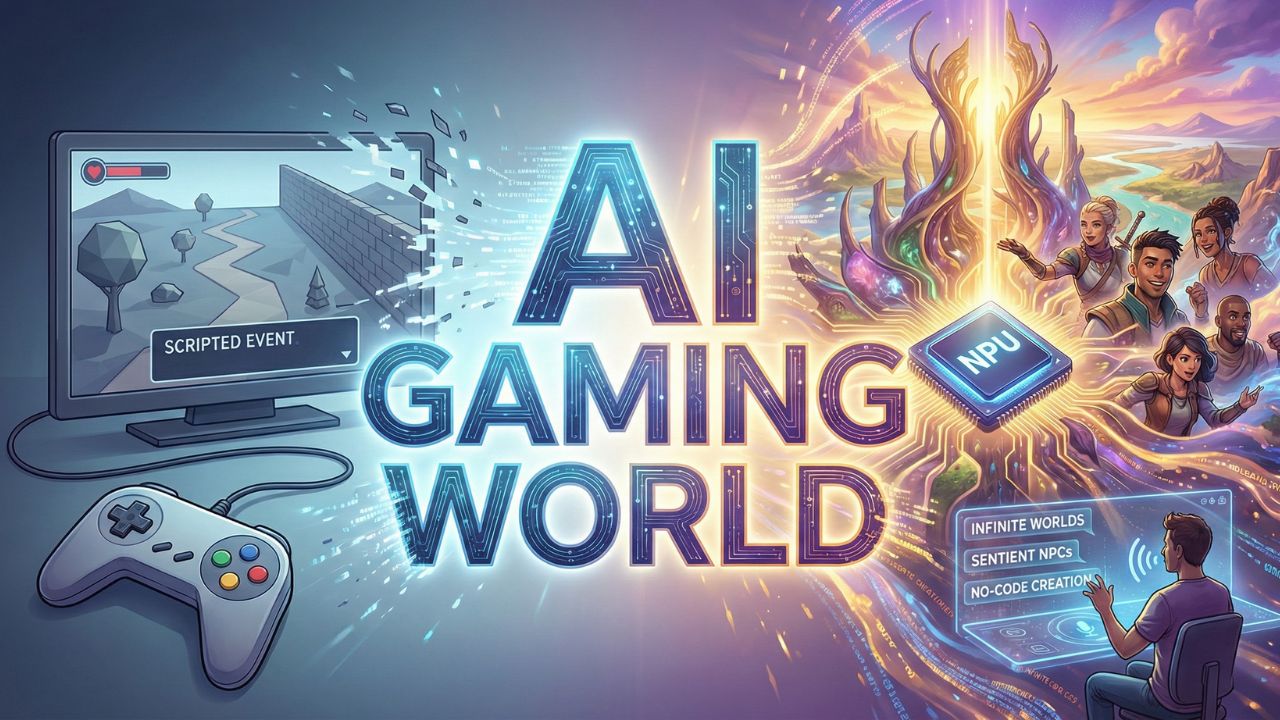
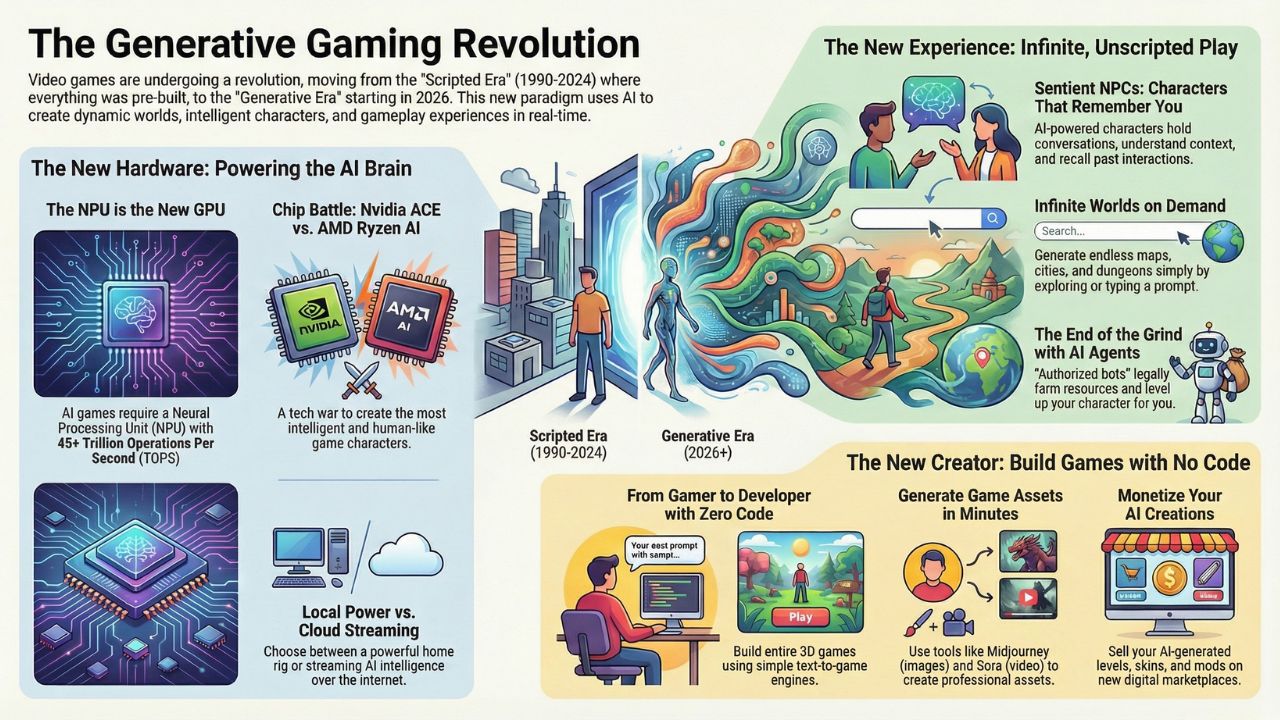
For the last three decades (1990–2024), video games have been a "Scripted Era". Developers hand-placed every tree, wrote every line of dialogue, and created maps with strict, invisible boundaries. If you played the game a second time, the story remained exactly the same, bound by the rigid architecture of the code written years prior.
By mid-2026, we have firmly entered the Generative Era. This is far more than a simple graphics rendering update; it is the absolute future of AI gaming. We are transitioning toward "Generative Gameplay," where worlds compile themselves in real-time based on player actions, characters maintain episodic memories of your interactions, and you transition from simply playing a game to actively co-creating its narrative.
This hub serves as your technical guide to this digital revolution. We break down the exact hardware specifications required to run these models natively, the new unscripted experiences arriving on the market, and how non-technical players are becoming full-stack developers using autonomous creation tools.
Part 1: The Hardware (Can Your PC Handle the "Brain"?)
Historically, building a gaming rig meant pouring your entire budget into the GPU. In 2026, the most critical bottleneck for next-generation immersion is the NPU (Neural Processing Unit). To run localized games featuring conversational characters and dynamic world-building logic, your computer requires dedicated silicon capable of executing at least 45 Trillion Operations Per Second (TOPS).
1. Can Your NPU Run GTA 6? (Local AI Gaming)
The next generation of open-world titles, including the highly anticipated GTA 6 ecosystem, face a new mandate: they cannot just look real; they must act real. Achieving this requires Local Large Language Models (LLMs) executing directly on your motherboard to generate unscripted dialogue instantly. Relying on remote cloud APIs for NPC interaction introduces a 200-to-400-millisecond latency penalty, destroying immersion. If you intend to run local models on consumer GPUs, you must evaluate your VRAM and NPU limits carefully. We analyze whether your current machine can handle the rigorous demands of generative AI inference.
Read: Can Your NPU Run GTA 6? The Reality of Local AI Gaming
2. Nvidia ACE vs. AMD Ryzen AI (The Chip Battle)
The silicon war has shifted from frame rates to cognitive capacity. Nvidia’s Avatar Cloud Engine (ACE) technology and AMD’s Ryzen AI architecture are competing aggressively to breathe life into digital avatars. We run rigorous benchmarks on latency, token-generation speed, and semantic comprehension to determine which chip manufacturer makes NPCs feel genuinely human rather than robotic text-to-speech generators.
Read: Nvidia ACE vs. AMD Ryzen AI: Who Wins the Battle for Smart NPCs?
3. The Best AI Gaming Laptops of 2026
Bulky desktop towers are no longer a strict requirement for high-end immersion. Hardware manufacturers are shipping laptops integrated with specific "AI Operating Systems" optimized for generative inference. We rank the top portable machines that confidently hit the 45+ TOPS threshold, allowing you to run autonomous agents seamlessly without melting your battery.
Read: The Best AI Gaming Laptops of 2026: Benchmarked for Generative Worlds
4. Cloud Gaming vs. Edge AI
Do you actually need to spend thousands on an RTX 5090? As broadband providers deploy advanced 6G architecture and companies report record-breaking data center GPU sales, "Cloud Gaming" is rapidly closing the latency gap. We examine the TCO (Total Cost of Ownership) to help you decide whether building a local supercomputer is necessary, or if streaming localized intelligence from an edge server provides a superior return on investment.
Read: Cloud Gaming vs. Edge AI: Do You Need an RTX 5090?
Part 2: The Experience (Sentient NPCs & Infinite Maps)
The rigid mechanics of selecting a pre-written response from a dialogue wheel are extinct. The 2026 standard is Sentience. Modern game engines now feature characters that parse your microphone audio, comprehend emotional context, and maintain a persistent database of your past interactions.
5. Top 10 Games with Sentient AI NPCs
Imagine a digital shopkeeper who refuses to sell you items because of an insult you muttered into your microphone three days prior. By leveraging technologies from Inworld AI and integrating advanced context windows, developers are rapidly bridging the "uncanny valley." We rank the top 10 titles that allow true voice-to-voice interaction with entities that exhibit emergent behavior.
Read: Top 10 Games with Sentient AI NPCs You Can Talk To (2026 Edition)
6. Roblox vs. Fortnite Creative (AI Map Generators)
Static map boundaries limit player retention. Artificial intelligence now compiles terrain, architecture, and complex dungeon logic endlessly as the player advances. We pit Roblox against Fortnite Creative to determine which platform offers superior "Text-to-World" capabilities, enabling users to spawn entire playable ecosystems via simple prompt engineering.
Read: Roblox vs. Fortnite Creative: Which AI Map Generator is Better?
7. The Death of the Grind (Authorized Botting)
Is utilizing an AI companion considered cheating, or just smart delegation? We analyze the integration of "Autonomous Agents" within MMOs. These AI proxies can farm materials, optimize inventory space, and execute repetitive leveling tasks while you focus on high-stakes raids. Incorporating agents with persistent memorychanges the entire philosophy of time-investment in gaming.
Read: The Death of the Grind: How AI Agents are Farm-Botting for You Legally
8. VR + AI: The "Holodeck" Experience
Fusing Virtual Reality hardware with Generative AI yields the "Holodeck" protocol—a spatial simulation that alters its physics and geometry based on voice commands. We review how the latest headsets from Meta and Apple utilize spatial computing combined with LLMs to render immersive, unscripted narratives directly in your living space.
Read: VR + AI: Creating 'Holodeck' Experiences in Your Living Room
Part 3: The Creator (Stop Playing, Start Building)
The technical barrier to entry for game development no longer exists. Mastering complex syntax in C++ or C# is now optional. The new "Creator Economy" relies entirely on No-Code AI infrastructure, where natural language dictates software logic.
9. Create a 3D RPG with Zero Code
If you can articulate a cohesive sentence, you possess the tools to construct a fully playable 3D Role-Playing Game. We outline a strict procedural guide utilizing text-to-game engines. By leveraging agentic workflows for code generation, beginners can bypass manual syntax errors and rapidly deploy complex rule sets, physics, and level designs.
Read: Stop Playing, Start Building: Create a 3D RPG with Zero Code
10. Midjourney & Sora for Game Assets
Historically, modeling textures and rendering cinematic cutscenes consumed thousands of developer hours. Today, text-to-video and text-to-image models accomplish this in seconds. We detail the precise prompt engineering required to command Midjourney and Sora, generating professional-grade UV maps, character sprites, and marketing trailers for independent releases.
Read: How to Use Midjourney & Sora to Create Game Assets
11. Monetizing AI Mods
Creating generative levels, custom skins, and localized AI logic is only the first step; extracting financial value is the second. We map out the decentralized marketplaces and modding hubs where creators legally sell AI-generated gaming assets, establishing the rules of engagement for this volatile digital economy.
Read: Monetizing AI Mods: Sell Generative Levels & Skins
Frequently Asked Questions (FAQ)
AI pushes gaming out of hard-coded, predictable loops into dynamic, unscripted environments. This technology deploys infinite terrains compiled in real-time, autonomous agents that execute complex resource gathering, and NPCs that understand contextual audio input.
For native execution without network bottlenecks, yes. Running an LLM directly on your motherboard requires a Neural Processing Unit (NPU) capable of 45+ TOPS. Cloud alternatives exist, but local hardware guarantees zero-latency conversational mechanics.
A sentient NPC operates on a localized large language model rather than a written script. They track conversation history, process the player's microphone input, and formulate unique, context-aware responses on the fly, eliminating repetitive dialogue loops.
Yes. The advent of AI-driven text-to-game engines allows individuals without programming expertise to construct rulesets, spawn 3D objects, and govern physics using plain English prompts.
Policies vary by publisher, but many 2026 titles natively support or tolerate "authorized botting" where players deploy personal API-driven agents to handle tedious grinding tasks, shifting the focus to high-level strategy.