VR + AI: Creating 'Holodeck' Experiences in Your Living Room
By Sanjay Saini | Original: Dec 31, 2025 | Last Updated: May 13, 2026
What's New in This Update (May 2026)
- Apple Vision Pro 2 Data: Updated specifications reflecting the M5 chip's real-time procedural rendering capabilities.
- Meta Quest 4 Launch: Added benchmarks for the new Snapdragon XR3 Gen 2 processor handling on-device AI spatial mapping.
- Procedural Generation Advances: Included 2026 updates on real-time 3D model generation latency dropping below 500ms using edge-compute APIs.
Key Takeaways
- Generative AI has eliminated the need for manual 3D modeling; you can now create VR worlds with voice prompts.
- Apple Vision Pro 2 relies on M5 chips to overlay photorealistic digital twins onto physical spaces seamlessly.
- Meta Quest 4 focuses on low-latency, dynamic level generation, turning real-world floor plans into interactive game arenas.
- The biggest hurdles remaining are thermal throttling, battery life, and the high token cost of sustained multi-modal API calls.
For decades, the "Holodeck" from Star Trek represented the pinnacle of science fiction. You walk into an empty room, issue a vocal command to a computer, and the physical space instantly transforms into a fully immersive, interactive environment.
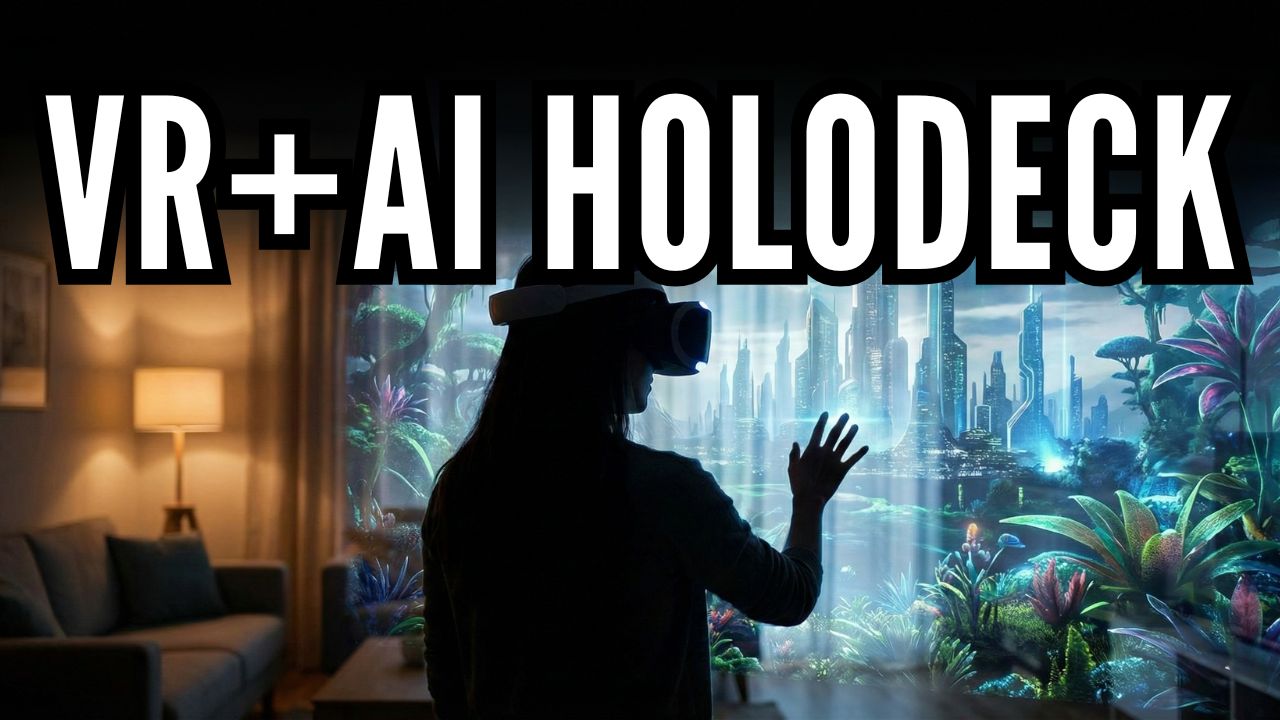
Through the rapid collision of generative artificial intelligence and high-fidelity Mixed Reality (MR), that science fiction concept is actively moving into consumer living rooms. We are moving past static, pre-rendered video games into an era where AI map generators build dynamic worlds around you in real-time.
The Shift from Virtual Reality to Mixed Reality AI
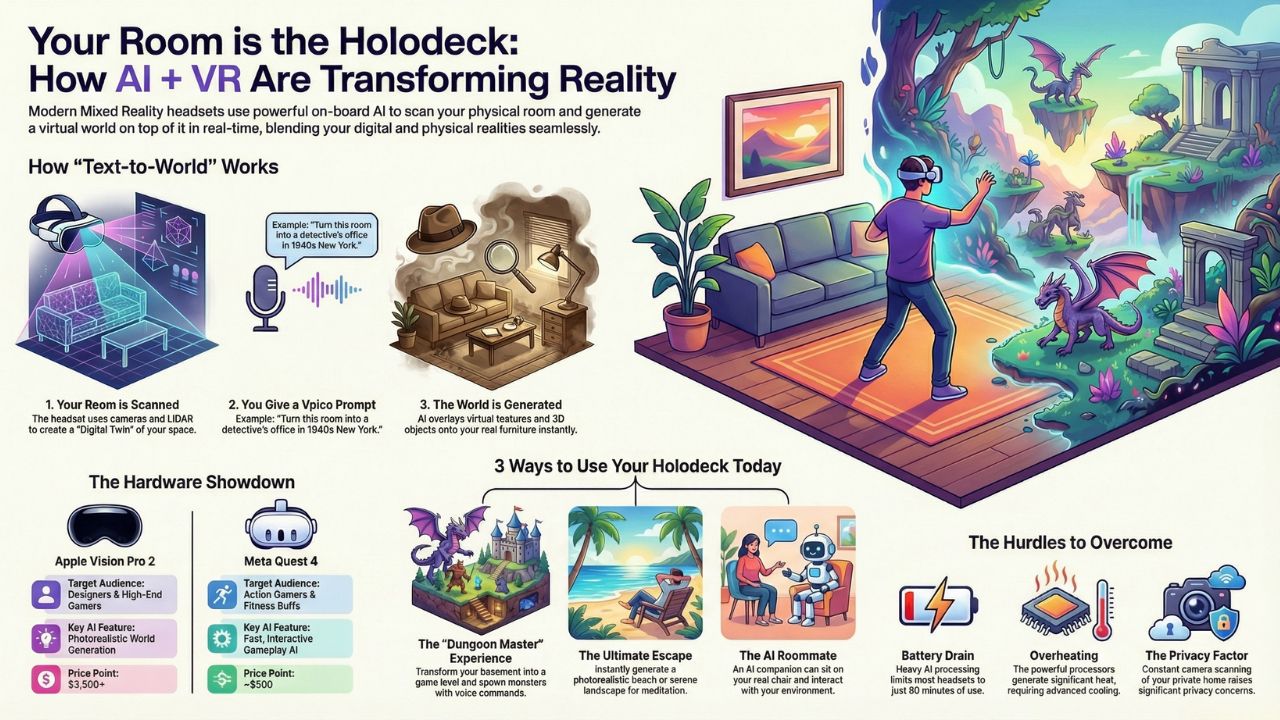
To understand the Holodeck, you must understand the distinction between Virtual Reality (VR) and Mixed Reality (MR). VR puts a screen over your eyes and isolates you from your physical surroundings. MR uses outward-facing cameras to capture your room in real-time, feeding that spatial data through an AI processor, and overlaying digital artifacts onto your actual furniture.
When you utilize generative AI for VR environments, the headset scans your living room couch and assigns it a digital physics collider. It then reskins that couch. Your hands feel the fabric of your real couch, but your eyes see a 1940s leather sofa in a noir detective scene. You are physically grounded in reality, but visually transported to a dynamically generated world.
Hardware Wars: Who Builds the Best Holodeck?
Two major technology giants are fighting to own the mixed reality ecosystem in your living room, taking vastly different approaches to silicon and software architecture.
Apple Vision Pro 2 (The "Cinema" Choice)
- Target Audience: Designers, Architects, and High-End Enthusiasts.
- The Engine: Apple M5 Chip + R2 Neural Engine.
Apple’s approach to Apple Vision Pro AI gaming centers entirely on photorealism and spatial accuracy. They have visualized "Siri Intelligence" so that it operates not just as a voice, but as an environmental architect.
If you ask Siri to "show me a Ferrari," a life-sized, photorealistic Ferrari appears in your physical driveway, anchored perfectly to the pavement. The shadow it casts updates dynamically as the real sun moves across the sky.
RoomPlan 3.0: The AI understanding of your physical room is virtually flawless. If you throw a digital ball, it will bounce off your physical wall and roll under your physical chair. It establishes "Spatial Memories," ensuring that if you leave a virtual book on your real-world desk, the headset remembers its precise coordinates and renders it there again tomorrow.
Meta Quest 4 (The "Gamer" Choice)
- Target Audience: Action Gamers and Fitness Enthusiasts.
- The Engine: Qualcomm Snapdragon XR3 Gen 2.
The Meta Quest 4 AI features prioritize ultra-low latency and interactive gameplay over absolute photorealism. While the textures may not rival Apple's silicon, the system excels at turning your environment into an active playground.
Procedural Dungeon Generation: The headset maps your house and turns it into a level geometry constraint. Your narrow hallway becomes a creeping dungeon corridor. Your kitchen island becomes a defensive bunker. The AI dynamically spawns enemies that recognize and navigate your specific floor plan.
Three Pillars of the Living Room Holodeck
1. Create VR Worlds with Voice Prompts
The most substantial barrier to 3D creation has historically been the steep learning curve of tools like Blender or Unreal Engine. In 2026, AI has abstracted the entire interface. New native integrations are wiring Large Language Models directly into 3D rendering pipelines.
Using systems powered by Luma AI or Blockade Labs, you simply speak: "Generate a dense cyberpunk marketplace at night, raining, with neon signs." Within seconds, the AI compiles a 360-degree skybox, populates 3D meshes, and applies collision physics.
2. Instant Escapism and Spatial Audio
Imagine coming home from an exhausting workday and sitting on the couch. Tell your headset: "Take me to a beach in Tahiti at sunset."
Using generative AI for VR environments, the hardware immediately renders a high-fidelity coastal environment. Crucially, it utilizes "Spatial Audio" driven by machine learning to manipulate acoustics, making the digital waves sound as though they are crashing against your physical floorboards. It provides instantaneous, tailored escapism.
3. The "AI Roommate" and Sentient Companions
Ecosystem: Inworld AI / Replika MR
We are seeing the rapid deployment of sentient AI NPCs transitioning from flat screens into mixed reality.
You can bring your AI companion into the real world. Your AI friend can sit on your physical chair, watch a movie with you (syncing its reactions to your actual television screen via computer vision), and engage in dynamic conversation. Because the AI utilizes the headset's external cameras as "vision," it can comment on what you are wearing or acknowledge if you clean up the room.
The Challenges: Heat, Battery, and Compute Constraints
The transition to a frictionless Holodeck reality faces severe infrastructural challenges that software alone cannot solve.
- Battery Physics: Running continuous spatial mapping, outward-facing cameras, and local AI processing simultaneously drains standard lithium-ion batteries in under two hours.
- Thermal Throttling: Generating real-time 3D assets locally pushes mobile chipsets to their thermal limits. Without active cooling, headsets quickly overheat and degrade performance to protect the silicon.
- Cloud Latency vs Edge Compute: Offloading the AI generation to the cloud requires massive bandwidth. If your API calls take longer than 20 milliseconds to return a rendered frame, the user will experience extreme motion sickness.Therefore, the industry is racing toward highly optimized, small-parameter edge models that run directly on the headset's NPU.
Frequently Asked Questions (FAQ)
Yes. Tools like Blockade Labs and Roblox Assistant allow you to build complex 3D scenes strictly through voice dictation. Generative AI translates your natural language into spatial geometry instantly.
Modern MR headsets utilize advanced Passthrough technology and depth sensors. If you approach a physical wall or obstacle, the system's spatial AI interrupts the virtual environment and reveals the real world to prevent injury.
The Apple Vision Pro 2 ($3,500+) offers unparalleled architectural precision and photorealism driven by its M5 chip. However, the Meta Quest 4 ($500) provides 90% of the interactive, dynamic gaming utility at a fraction of the cost.
Virtual Reality entirely obscures your physical surroundings. Mixed Reality uses outward cameras to seamlessly blend generated digital objects with your actual physical space. The living room Holodeck relies on MR to map and utilize your real furniture.
Final Thoughts on the Living Room Holodeck
The convergence of real-time 3D generation and spatial computing guarantees that our relationship with digital entertainment is fundamentally changing. As thermal constraints are solved and on-device NPUs become more powerful, your physical living room will transition into a blank canvas. Decide whether you want an ecosystem tailored for cinematic design (Apple) or dynamic gaming (Meta), and prepare to step inside.