Monetizing AI Mods: How to Sell Your Generative Levels & Skins
What's New in This Update (May 2026)
- Asset Market Projections: Included 2026 data highlighting the $2.08 billion AI game assets generator market value.
- Updated Store Policies: Reflected new guidelines from Steam and the Unity Asset Store regarding the sale of AI-generated content.
- Expanded Legal Landscape: Added fresh context around the copyright risks and human authorship requirements for derivative 3D items.
- Workflow Enhancements: Added more specific methodologies for creating 3D skins using modern tools to match current workflows.
Key Takeaways
- The global market for AI game asset generation is exploding, offering massive passive income opportunities for independent creators.
- You do not need a massive game studio to profit; solo developers successfully sell micro-assets like weapon skins, textures, and NPC personality configurations.
- Major distribution marketplaces like Steam, Unity Asset Store, and Overwolf explicitly permit AI content, but they mandate strict disclosure labels.
- Selling derivative work (like a "Cyberpunk Mario" model) remains a dangerous trademark violation; prioritize fully original conceptual designs.
The Era of "Free Work" is Over.
For two decades, modders operated as the unsung heroes of the video game ecosystem. They patched bugs, constructed fresh maps, and sustained titles like Skyrim for ten years—typically performing this labor entirely for free, supported only by a "Donation" button that few players ever clicked.
By 2026, the creator economy for gamers has fundamentally transformed. Supported by platforms establishing direct developer-to-creator payouts, talented individuals now build lucrative careers selling the exact modifications and assets they engineer using artificial intelligence.
According to current market analysis, the global AI game assets generator market reached $2.08 billion in 2026. This guide breaks down exactly how to claim a piece of that market, where to list your creations, and the strict legal parameters you must follow to avoid litigation.
Explore AI Gaming 2026 Hub
- AI Gaming World: Infinite Play & Generative Worlds
- Can Your NPU Run GTA 6? The Reality of Local AI Gaming
- Nvidia ACE vs. AMD Ryzen AI: Who Wins the Battle for Smart NPCs?
- Best AI Gaming Laptops 2026: Benchmarked & Ranked
- Cloud Gaming vs. Edge AI: Do You Need an RTX 5090?
- Top 10 Games with Sentient AI NPCs You Can Talk To (2026 Edition)
- Roblox vs. Fortnite Creative: Which AI Map Generator is Better?
- The Death of the Grind: How AI Agents are Farm-Botting for You Legally
- VR + AI: Creating 'Holodeck' Experiences in Your Living Room
- Stop Playing, Start Building: Create a 3D RPG with Zero Code
- How to Use Midjourney & Sora to Create Game Assets
Part 1: What Can You Actually Sell?
Entering this market does not require you to program an entire video game. The modern economy thrives on "Micro-Assets"—small, highly specific digital items that independent developers or players purchase to enhance their immediate experience.
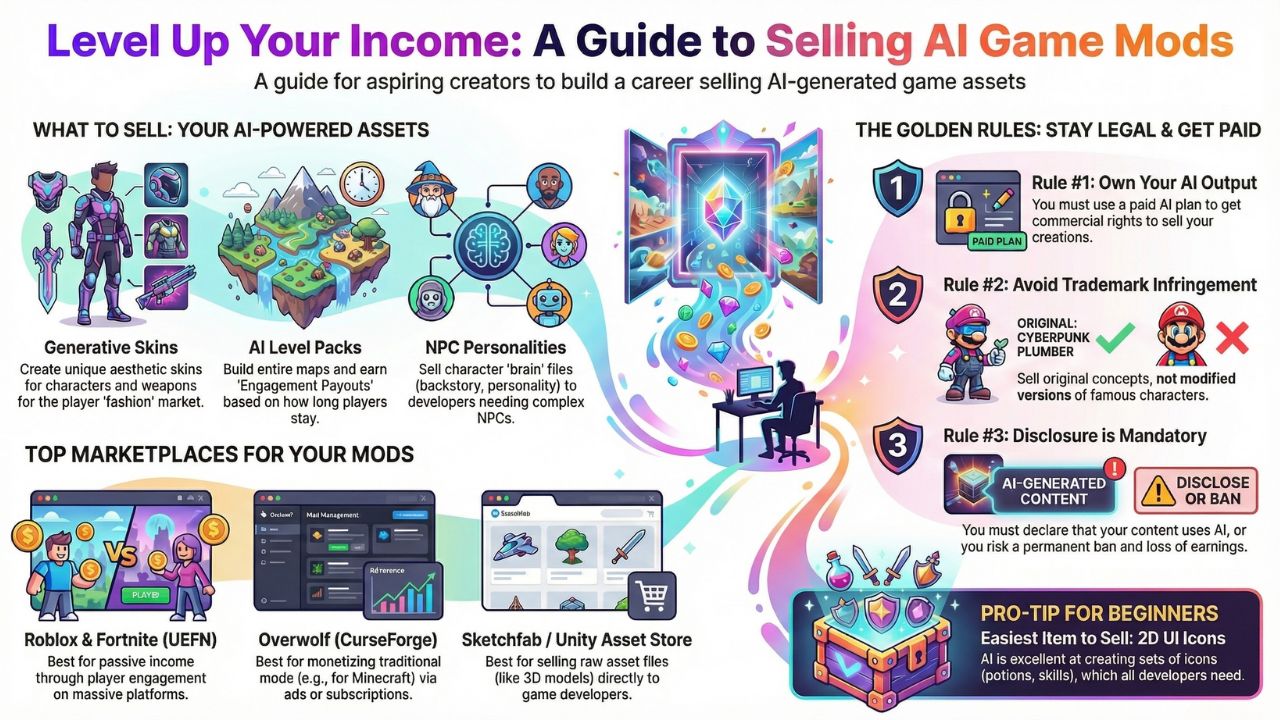
1. Generative Skins (The "Fashion" Market)
Leveraging tools like Midjourney alongside 3D generation models such as Meshy or Hitem3D, independent artists produce highly detailed cosmetic skins for weapons, armor, and characters.
The Opportunity: In competitive multiplayer games like CS:GO 2 or Roblox, players gladly spend real currency on aesthetic upgrades that do not alter gameplay mechanics. An individual creator can generate fifty variations of a "Neon Dragon Rifle" texture in an hour, isolate the highest quality design, and list it for sale.
2. AI Level Packs (The "Experience" Market)
Engines like Roblox Assistant and Fortnite Unreal Editor for Fortnite (UEFN) enable non-technical creators to construct entire playable maps using natural language prompts.
The Model: You generally do not sell these maps for an upfront fee. Instead, you earn through "Engagement Payouts." The longer active players inhabit your AI-generated "Zombie Survival" arena, the higher your monthly platform dividend. Top-tier creators consistently earn substantial incomes relying solely on this engagement metric.
3. NPC Personalities (The "Soul" Market)
A rapidly expanding sector in 2026 revolves around cognitive assets. Developers utilizing conversational engines frequently search for pre-built "Character Profiles" to populate their worlds.
What it is: You draft the detailed backstory, core personality traits, and episodic memories for a complex AI character (for example, a paranoid 1920s private investigator). You then sell this "Brain" file—a structured JSON or prompt framework—to indie developers who need to integrate sentient AI NPCs into their gameswithout writing the complex behavioral logic themselves.
Part 2: The Best Marketplaces for AI Game Assets
Once you generate a high-quality asset, you need a storefront. The landscape of digital marketplaces has adapted quickly to the influx of generative content.
1. The Giants: Roblox & Fortnite (UEFN)
- Best For: Securing passive income via engagement.
- Pros: You gain immediate access to a massive, built-in audience containing millions of daily active players.
- Cons: You surrender pricing control; the platform's proprietary algorithm dictates your earnings based entirely on player retention metrics.
2. Overwolf (CurseForge)
- Best For: Distributing traditional modifications for legacy titles like Minecraft or World of Warcraft. Overwolf pioneered the concept of "Monetized Modding."
- They permit top-tier creators to inject non-intrusive advertising into their mod packs or offer premium subscription tiers for exclusive content updates.
3. Unity Asset Store & Sketchfab
- Best For: Selling "Raw" production files to working developers. If you utilize AI to generate a highly detailed 3D medieval castle, you can sell the raw .FBX or .OBJ file directly.
- Independent developers frequently browse these platforms hunting for affordable, high-quality environmental assets to populate their game worlds rapidly. As of 2024, the Unity Asset Store officially permits AI-generated content, provided creators explicitly disclose the tooling used.
Part 3: The Legal Guide to Selling Mods (2026 Edition)
Warning: Navigating the ethics of AI-generated assetsis the most critical aspect of your business. Do not skip this section.
Rule #1: Do You Own the AI Output?
Just because you prompted the machine does not guarantee you possess commercial rights to the output. If you are wondering if you can copyright AI art, the rules depend heavily on the platform.
- Midjourney and OpenAI: If you operate on a Paid Subscription Plan, the terms of service grant you the commercial rights to sell the images and text you generate.
- Free Plans: In almost all cases, free-tier users do not receive commercial rights. Selling assets generated on a free trial exposes you to immediate legal action and platform bans.
Rule #2: The "Derivative Work" Trap
You cannot take a copyrighted character like Mario, run the image through an AI filter to produce "Cyberpunk Mario," and list it for sale. This constitutes blatant trademark and copyright infringement.
The Golden Rule: Exclusively sell highly original concepts. A generic "Cyberpunk Plumber" character model is legally safe; a model featuring a recognizable red hat and an "M" logo is strictly prohibited.
Rule #3: Disclosure is Mandatory
Marketplaces are enforcing strict transparency. Platforms including Steam, Epic Games Store, and Unity now mandate that creators explicitly check a disclosure box stating: "This content was created with AI assistance."
Penalty: If you conceal your use of AI and community moderators discover the deception, platforms will permanently ban your account and seize any pending earnings.
Part 4: How to Make Money with AI Gaming (Step-by-Step)
If you are exploring the best AI passive income ideas, creating digital gaming assets offers a high ceiling with zero physical inventory. Here is a proven roadmap to launch your storefront:
- Day 1: Utilize Midjourney to generate a cohesive "Texture Pack" (for example, seamless Realistic Lava, Alien Grass, and Rusted Metal).
- Day 2: Process the images using an AI upscaler and Midjourney's native tile feature to ensure they tile seamlessly across large 3D surfaces.
- Day 3: Compile the textures into a structured, well-organized zip file containing 50 unique variations.
- Day 4: Draft a compelling product description and list the pack on the Unity Asset Store for $5.
- Day 5: Drive traffic by posting a short demonstration video on TikTok or Reddit, showcasing the textures applied to a simple 3D environment.
- Repeat: Apply this exact workflow to 2D UI Icons, skill tree graphics, or even AI print-on-demand designsfor gaming merchandise.
Frequently Asked Questions (FAQ)
Top Roblox creators earn millions in engagement payouts. However, a realistic baseline goal for a solo creator selling asset packs on traditional marketplaces is $500 to $2,000 per month in passive income, provided you build a robust portfolio of twenty or more high-quality items.
Yes. Following a period of restriction, Steam officially updated its policy in 2024 to allow AI-generated content. Developers must clearly disclose the presence of AI during the submission process, and the content must not contain any illegal or copyright-infringing material.
2D UI Icons are consistently the most accessible entry point. Every role-playing game requires hundreds of unique icons for health potions, iron swords, and magical abilities. AI models excel at generating these isolated 2D elements, and solo developers gladly purchase affordable bundles rather than illustrating them manually.