Can Your NPU Run GTA 6? The Reality of Local AI Gaming
What's New in This Update (May 2026)
- New 45 TOPS Minimum Standard: Updated benchmarks reflecting the latest developer guidelines for deploying local LLMs inside open-world engines.
- Cloud vs Edge Economics: Added an analysis of latency barriers confirming why cloud APIs fail for conversational NPCs.
- VRAM Dependency Clarified: Detailed the critical relationship between NPU processing speed and GPU memory allocation for running 7B-parameter agent models.
Key Takeaways
- To run unscripted, conversational NPCs natively without cloud lag, your gaming PC requires a Neural Processing Unit (NPU) rated for at least 45 TOPS.
- Relying solely on your GPU for both graphics rendering and AI logic will cause catastrophic frame drops; the NPU offloads the "thinking."
- Cloud gaming APIs introduce a 200–500ms latency penalty, breaking conversational immersion in generative titles like GTA 6.
- Hardware without an NPU will still run these games, but will likely revert characters to rigid, pre-scripted dialogue trees.
Stop! Do not upgrade your graphics card just yet.
For the last 20 years, if you wanted to play the newest open-world blockbuster, you bought a better Graphics Card (GPU). You looked for marketing terms like "Ray Tracing," "DLSS," and "FPS."
But in 2026, the architectural rules of game design have permanently changed.
The next generation of games, starting with titles matching the scale of Grand Theft Auto VI, won't just look real—they will think real. Developers are abandoning rigid dialogue trees in favor of Artificial Intelligence, creating characters that talk to you via microphone without a pre-written script. If you want to play games featuring sentient AI NPCs, your hardware needs a complete paradigm shift.
To run these generative games seamlessly, your computer needs a new, dedicated brain.
This technical guide breaks down why the Neural Processing Unit (NPU) is the new mandatory component for next-generation immersion and answers the most critical hardware question of the decade: Can your current NPU run GTA 6?
Explore AI Gaming 2026 Hub
- AI Gaming World: Infinite Play & Generative Worlds
- Nvidia ACE vs. AMD Ryzen AI: Who Wins the Battle for Smart NPCs?
- Best AI Gaming Laptops 2026: Benchmarked & Ranked
- Cloud Gaming vs. Edge AI: Do You Need an RTX 5090?
- Top 10 Games with Sentient AI NPCs You Can Talk To (2026 Edition)
- Roblox vs. Fortnite Creative: Which AI Map Generator is Better?
- The Death of the Grind: How AI Agents are Farm-Botting for You Legally
- VR + AI: Creating 'Holodeck' Experiences in Your Living Room
- Stop Playing, Start Building: Create a 3D RPG with Zero Code
- How to Use Midjourney & Sora to Create Game Assets
- Monetizing AI Mods: Sell Generative Levels & Skins
What is an NPU and Why Does GTA 6 Need It?
To understand the hardware shift, think of your computer's silicon architecture like a high-end commercial kitchen.
- CPU (Central Processing Unit): The Head Chef. It manages the overarching physics, physics calculations, and general game logic.
- GPU (Graphics Processing Unit): The Plating Artist. It ensures the environment renders flawlessly, managing textures, lighting, and ray tracing.
- NPU (Neural Processing Unit): The specialized "Smart Assistant." It exists exclusively to run matrix math and neural network inference efficiently.
In the past, video games were essentially static geometry moving on a screen. But GTA 6 generative NPC specs indicate a dramatic shift: characters in the game will possess localized cognition. Powered by systems similar to Nvidia ACE or AMD Ryzen AI, these digital avatars maintain conversational memory, react dynamically to your voice, and synthesize responses in real-time.
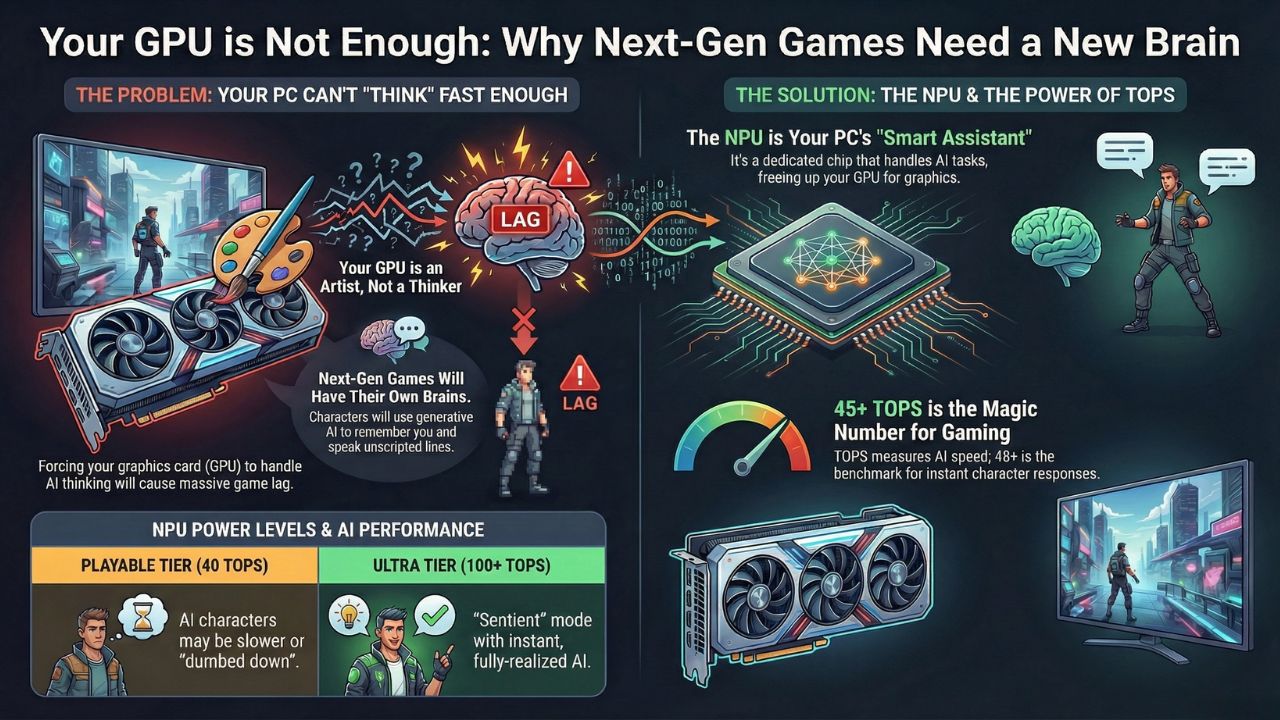
Your GPU is already pushed to its maximum limit drawing a sprawling, ray-traced city at 60 frames per second. If developers force the GPU to simultaneously process natural language generation and "think" for 50 different NPCs in a crowd, your game will suffer catastrophic frame-rate drops. The NPU solves this bottleneck. By offloading the AI inference tasks to the NPU, your system maintains graphical fidelity while simultaneously running local Large Language Models (LLMs).
The technical reality: If you want autonomous characters who synthesize unscripted dialogue without crippling your system's rendering performance, an NPU is non-negotiable.
The Magic Number: 45 TOPS
When shopping for 2026 hardware, you will encounter a new metric dominating laptop and motherboard boxes: TOPS. This acronym stands for "Trillion Operations Per Second" and acts as the benchmark for how rapidly your AI silicon can calculate neural workloads.
- 10 to 20 TOPS: Sufficient for background tasks like blurring your webcam background on Zoom or basic photo noise reduction.
- 40 TOPS: The strict baseline mandated by Microsoft to qualify a machine for native Windows Copilot+ features.
- 45+ TOPS: The established gaming benchmark required to run local, 7B-parameter agent models for sentient characters without intolerable latency.
When hunting for the best AI gaming laptops on the market, securing a chip that guarantees sustained 45+ TOPS performance is critical. If your hardware falls short of this threshold, the localized AI models governing the game's NPCs will bottleneck. This results in the character taking three to four seconds to process your microphone input and formulate a response.
Imagine initiating a conversation with a digital shopkeeper and staring at a blank screen for five seconds while your processor struggles to generate text. The immersion is instantly destroyed. High TOPS guarantees millisecond responsiveness.
The Great Debate: Local AI vs. Cloud Gaming for GTA 6
If upgrading your hardware sounds too expensive, you might wonder about the alternative: utilizing the cloud. When evaluating local AI versus cloud gaming for unscripted titles, the decision hinges on the battle between latency and budget.
Option A: Edge AI (Local Execution)
- How it works: The game's language models and behavioral logic execute natively on your motherboard, utilizing a high-end NPU (like those found in AMD Ryzen AI 300 processors or dedicated RTX 50-series infrastructure).
- Pros: Zero API latency. When you speak to an NPC, the response is synthesized and delivered instantly. You retain total privacy, and your game remains fully functional without an internet connection. If you are a developer learning how to run LLMs locally, this exact architecture mirrors your programming environment.
- Cons: A substantial upfront financial investment is required to procure the necessary silicon.
Option B: Cloud AI (Streaming Intelligence)
- How it works: Your game sends your microphone audio to a remote server farm. A massive data center processes the natural language, generates the NPC's response, and streams the audio back to your client.
- Pros: Vastly lower barrier to entry. You can theoretically run these advanced conversational mechanics on outdated laptops, relying on the publisher's remote hardware.
- Cons: The "Round Trip Time" (RTT) is brutal. Even on high-speed fiber optics, routing audio to a cloud API, awaiting inference, and streaming it back introduces 200 to 500 milliseconds of latency. In a fast-paced gaming environment, this delay makes conversations feel unnatural and disjointed.
Our Verdict: For genuine immersion, edge computing wins decisively. You want the brain situated directly on your desk, calculating tokens at hardware speed.
GTA 6 System Requirements: The AI Edition
While Rockstar Games maintains strict confidentiality regarding final PC specifications, the trajectory of generative development engines provides a clear blueprint. If you are building a rig today to survive the 2026 software cycle, these are the projected AI-specific tiers:
The "Playable" Tier (Scripted Fallback)
- Hardware: Legacy CPUs or NPUs falling below 30 TOPS.
- The Experience: The game will render beautifully, but the "brain" is disabled. The game engine detects insufficient local compute and reverts NPCs to traditional, pre-recorded dialogue trees. You experience the world exactly as you did in 2013's GTA 5—beautiful, but entirely scripted.
The "Generative Ultra" Tier (Sentient Mode)
- Hardware: An NPU sustaining 45+ TOPS combined with a minimum of 16GB of VRAM dedicated to the GPU (crucial for loading the weights of the local agent models into memory).
- The Experience: The simulation unlocks its full potential. Every pedestrian possesses a unique, hallucination-free backstory, remembering your actions and generating endless, context-aware missions on the fly.
Frequently Asked Questions (FAQs)
No. An NPU is a physical piece of silicon soldered onto your motherboard or integrated directly into your processor die. It cannot be downloaded via software patches. If your current CPU lacks neural architecture, you must physically upgrade your hardware.
Almost certainly, yes. Major publishers cannot alienate millions of existing console and PC players. However, without an NPU, the engine will likely disable the generative AI features. Characters will revert to using hard-coded, scripted voice lines, missing the dynamic conversational mechanics defining the 2026 era.
Currently, the most cost-effective path to achieving 45+ TOPS is through the AMD Ryzen AI 300 series laptops or equivalent Intel Core Ultra mobile processors. These integrated systems provide sufficient neural compute for localized gaming agents without requiring a massive, multi-thousand-dollar desktop graphics card.
Latency is the enemy of immersion. Routing your voice audio to a remote server, waiting for a language model to infer a response, and streaming the synthesized audio back introduces 200 to 500 milliseconds of delay. Local NPUs process this data on your machine instantly, enabling natural, overlapping conversation.
Sources and References
- What is an NPU? Why Your Next Laptop Needs 45+ TOPS for AI
- NVIDIA ACE (Avatar Cloud Engine) Documentation
- AMD Ryzen AI Technical Specifications
- Inworld AI: The Future of Video Games (2026 Update)
- Intel Core Ultra Processors (NPU Architecture Explained)
- Unity Muse and Sentient AI Integration
- Microsoft Copilot+ PCs (40 TOPS Minimum Benchmarks)