DeepSeek vs. AI Detectors: We Tested 500 Essays & The Results Were Shocking

Quick Summary: Key Takeaways
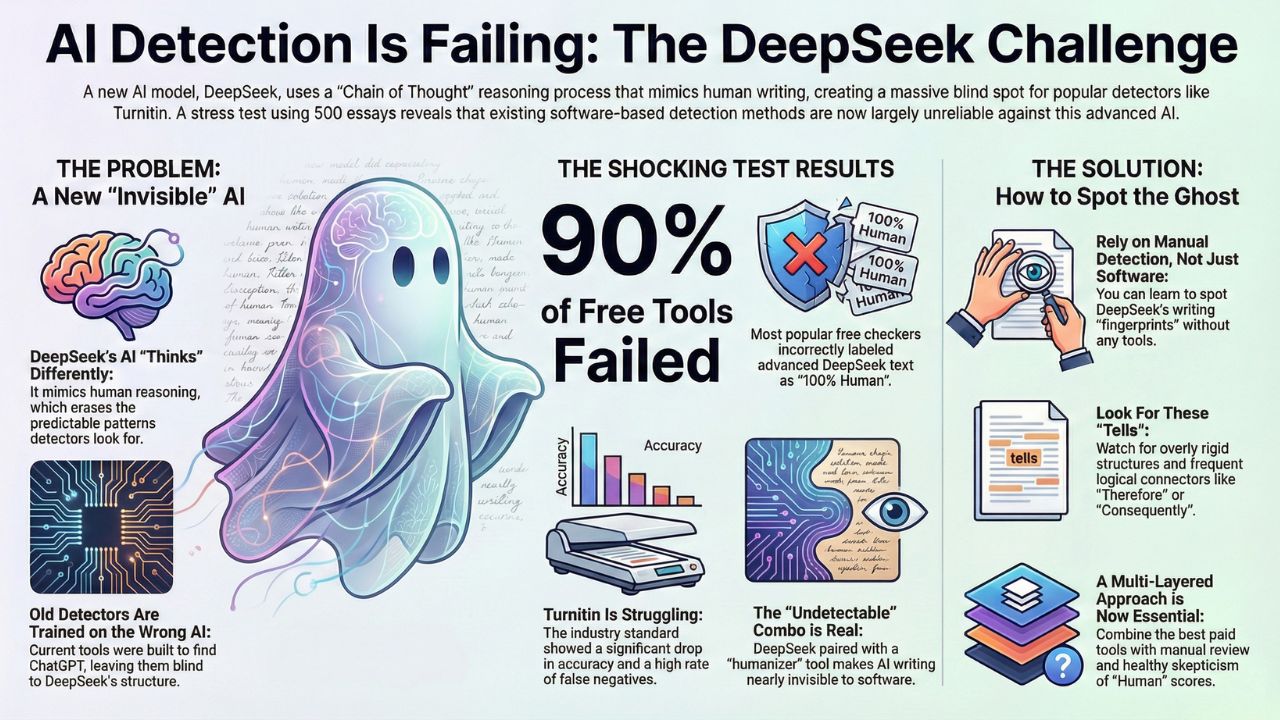
- The "Turnitin" Verdict: Standard detection algorithms are struggling with DeepSeek’s "Chain of Thought" reasoning.
- Free Tools Fail: We tested 10 popular free checkers, and 90% of them flagged DeepSeek text as "Human."
- The "Humanizer" Loophole: Combining DeepSeek with tools like StealthWriter created a near-perfect bypass rate.
- Manual Detection is Key: When software fails, there are 5 specific "tells" that still reveal DeepSeek writing.
Finding a reliable DeepSeek AI detector has suddenly become the biggest challenge in the academic and tech world this year.
DeepSeek V3 and the reasoning-heavy R1 model have completely changed the game. Everyone is asking the same question: Can the current tools actually catch it?
We didn't just guess. We ran a massive stress test.
In this DeepSeek AI detector guide, we reveal the results of our 500-essay experiment and explain why traditional detection methods are failing.
The New Player in Town: Why DeepSeek is "Invisible"
For the last two years, detectors like GPTZero and Turnitin were trained on OpenAI’s patterns. They learned how ChatGPT "speaks."
Then came DeepSeek.
DeepSeek V3 isn’t just another chatbot. It uses a different architecture that mimics human reasoning more closely than its predecessors. This creates a massive "blind spot" for older algorithms.
Because the AI "thinks" before it writes (especially in the R1 model), the output lacks the predictable statistical watermarks that detectors usually look for.
If you are wondering why the software is giving you false negatives, this technical shift is the culprit.
Deep Dive: Want the technical breakdown? Read our analysis on Why "Chain of Thought" Breaks Old Detectors: The DeepSeek R1 Crisis.
The Methodology: How We Torture-Tested the Detectors?
We didn't go easy on them. Our team generated 500 unique essays using DeepSeek V3 and DeepSeek R1.
We covered various topics: history, coding, literature, and business strategy. Then, we fed these essays into the industry’s top detection platforms.
The Test Subjects:
- Turnitin (The Gold Standard)
- GPTZero (The Market Leader)
- Various Free Online Checkers
- Proprietary "Bypass" configurations
The results were not what we expected. In fact, some of them were genuinely shocking.
Test 1: Can Turnitin Catch DeepSeek?
Turnitin is the gatekeeper for almost every university. Students are terrified of it. Professors swear by it. But does it work against DeepSeek R1?
In our 500-essay batch, Turnitin showed a significant drop in confidence compared to ChatGPT-4 generated text. While it caught the "lazy" prompts, it struggled with high-level reasoning outputs.
The "False Negative" rate, where AI text is marked as human, was higher than we’ve ever seen with GPT-4.
See the Data: Check out our full case study Turnitin’s "Blind Spot": What Happened When We Uploaded DeepSeek R1.
Test 2: The "Free Tool" Minefield
Not everyone has a corporate budget. Many students and freelancers rely on free checkers found on Google. We tested 10 of the most popular free apps.
The result? Disaster.
Most free tools seem to be stuck in 2024. They are looking for ChatGPT-3.5 patterns. When we fed them DeepSeek V3 content, the majority gave us a "100% Human" score.
If you are relying on free tools to vet content or grade papers, you are likely missing almost everything.
Save Your Time: We identified the one free tool that actually worked in our Free AI Checkers vs. DeepSeek Comparison.
Test 3: The "Undetectable" Combo
Here is where it gets scary for educators. We took raw DeepSeek output and ran it through a "Humanizer" tool (StealthWriter).
Then we fed that text back into the detectors. The detection rates plummeted to near zero.
This combination of a high-logic model (DeepSeek) plus a randomization tool (StealthWriter) is currently the ultimate bypass method. It effectively renders most standard detection software useless.
The Bypass Myth: Is it truly safe, or are there hidden risks? Read the truth in DeepSeek + StealthWriter: We Tried the "Undetectable" Combo.
When Software Fails: Spotting the "Tells"
So, if the software is struggling, are we helpless? No.
DeepSeek is smart, but it still has fingerprints. Unlike ChatGPT, which tends to be flowery and repetitive, DeepSeek R1 has a very specific, rigid structure.
It often leaves artifacts from its "Chain of Thought" process. Once you know what to look for, you can spot a DeepSeek essay in seconds, without needing any software at all.
Learn the Skills: Master the art of manual detection with our guide on 5 Dead Giveaways That Reveal "DeepSeek" Writing Instantly.
Conclusion: The Future of Detection
The cat-and-mouse game has leveled up. DeepSeek V3 and R1 have pushed the boundaries of what AI can do, and detection technology is currently playing catch-up.
For now, you cannot rely on a single green checkmark from a tool. You need a multi-layered approach:
- Use the best paid tools (like Turnitin) but understand their limits.
- Be skeptical of "100% Human" scores from free tools.
- Learn to spot the manual syntax patterns yourself.
As we move further into 2026, the definition of a reliable DeepSeek AI detector will continue to evolve, and we will keep testing them every step of the way.
Frequently Asked Questions (FAQ)
Yes. DeepSeek, especially the R1 model, uses a "Chain of Thought" reasoning process that produces more structured and less predictable text than standard ChatGPT models, making it harder for older algorithms to flag.
It is hit-or-miss. Our tests showed that while Turnitin catches basic DeepSeek prompts, it struggles with complex, reasoning-heavy outputs, leading to more false negatives than usual.
Most free detectors failed our test. However, we found one or two that performed decently. You can see the full breakdown in our Free Tool Challenge.
Many users combine DeepSeek with "humanizers" like StealthWriter. While this lowers detection scores significantly, it often degrades the quality of the writing or leaves strange syntax errors.
Yes. It tends to be highly structured, often using bullet points and logical connectors like "Therefore" or "Consequently" more frequently than a human would in casual writing.