Best AI Marketing Tools 2026: The "Agentic" Stack (Review)
Forget Jasper. We review the top Agentic Marketing Tools of 2026. Head-to-head comparison of HubSpot Breeze, Salesforce Agentforce, and custom Python swarms.
The Shift: From "Assistants" to "Agents"
In 2024, we bought tools that helped us write. In 2026, we are buying tools that do the work.
This is the year of the Autonomous Marketing Software. The market has split into two camps: the "All-in-One" enterprise ecosystems and the "Do-It-Yourself" code-based swarms.
If you are a CMO or an Agency Owner, you are likely staring at a six-figure decision: HubSpot Breeze vs. Salesforce Agentforce.
Or, if you are bold, building your own AI marketing stack 2026 with CrewAI.
We tested them all. Here is the definitive review.
Explore Generative Engine Optimization (GEO) 2026 Hub
- Generative Engine Optimization (GEO) 2026: The Ultimate Guide to Ranking in AI Search
- Audit Your Brand on AI: How to Control What ChatGPT Says About You
- Build a Marketing Agent Swarm: CrewAI Tutorial 2026
- Video SEO 2026: Ranking in Sora, Veo, and YouTube AI
- Zero-Click Content Strategy: How to Monetize Without Traffic
- GEO in India: Optimizing for 'Hinglish' and Voice Search
The Agent Capability Matrix
Before we dive into the reviews, let’s look at the specs. We graded these platforms on three critical "Agentic" criteria:
- Autonomous Decision Making: Can the agent say "No" or change plans without asking you?
- Self-Healing Workflows: If an API fails, does the agent fix it or crash?
- Multi-Modal Output: Can it generate text, code, and images in one workflow?
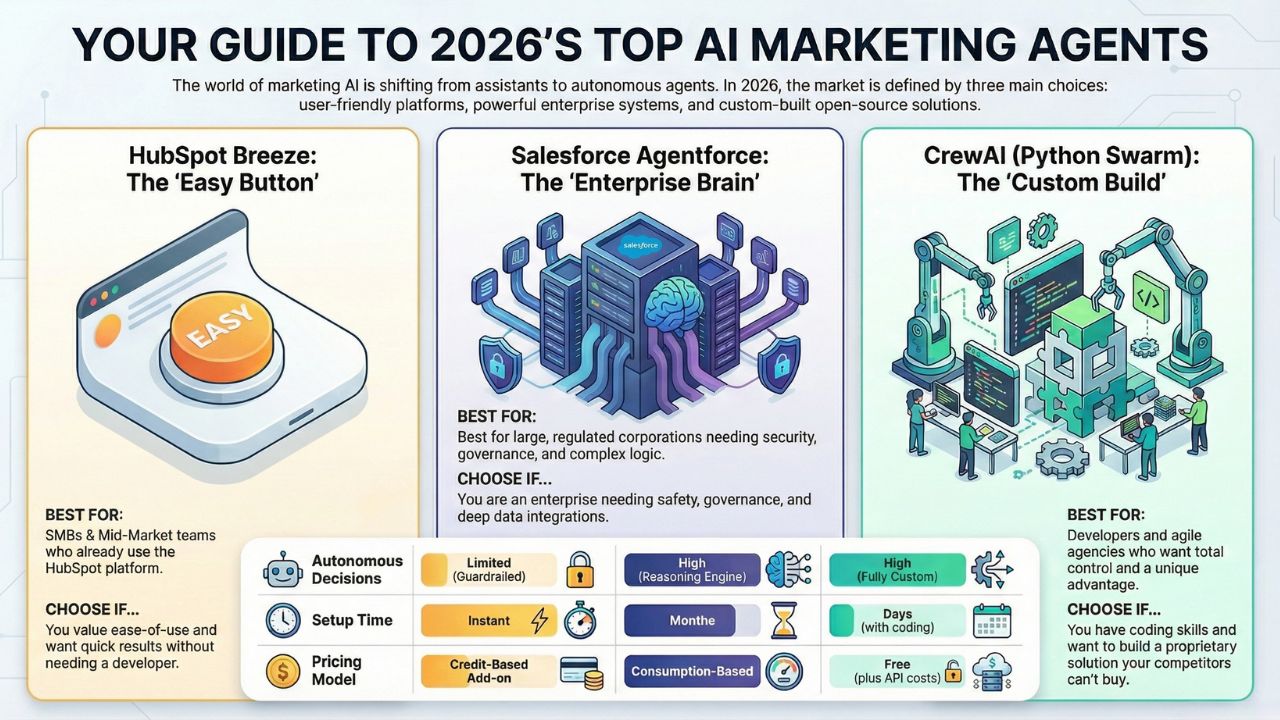
| Feature | HubSpot Breeze | Salesforce Agentforce | CrewAI (Python Swarm) |
|---|---|---|---|
| Best For | SMBs & Mid-Market | Enterprise & Regulated Industries | Developers & Agile Agencies |
| Autonomous Decisions | Limited (Guardrailed) | High (Reasoning Engine) | High (Fully Custom) |
| Self-Healing | No (Fails safely) | Partial (Atlas Reasoning) | Yes (If coded correctly) |
| Multi-Modal | Text & Image | Text & Data Viz | Unlimited (Via API) |
| Setup Time | Instant (Click & Play) | Months (Consultants needed) | Days (Requires Coding) |
| Pricing Model | Credit-Based Add-on | Consumption ($2/convo) | Free (Open Source) + API Costs |
1. HubSpot Breeze Review: The "Apple" of AI Agents
The Promise: "AI that just works."
The Reality: It is the easiest way to deploy agents, but you play by their rules.
HubSpot Breeze isn't a single tool; it's a layer of intelligence across their entire platform.
Their standout feature is the "Prospecting Agent." This isn't a chatbot; it proactively researches leads in your CRM, drafts personalized emails based on their recent LinkedIn activity, and queues them for approval.
Pros:
- Unified Data: It hallucinates less because it is grounded in your actual CRM data (Smart CRM).
- The "Social Agent": One of the few tools that can autonomously create and schedule LinkedIn posts based on trending news.
- No Code: You don't need a developer. You toggle it on.
Cons:
- Rigid Workflows: You cannot easily "teach" the agent a new trick if it's not in the HubSpot playbook.
- Credit Burn: The "Breeze Credits" system can get expensive if you have high volume.
Bottom Line: If you already use HubSpot, this is a no-brainer. It effectively adds a junior marketer to your team for a few hundred dollars a month.
2. Salesforce Agentforce Review: The Enterprise Brain
The Promise: "Humans with Agents driving customer success."
The Reality: A powerhouse for corporations that need governance, security, and complex logic.
Salesforce Agentforce pricing is controversial ($2 per conversation in some models), but the power is undeniable.
Unlike Breeze, which feels like a set of tools, Agentforce feels like an employee. It uses the Atlas Reasoning Engine, allowing it to plan complex paths.
Pros:
- Reasoning: If you ask it to "Help this customer," it figures out the steps (Check order status > refund > email apology) autonomously.
- Data Cloud Integration: It can pull data from Snowflake, Google Cloud, and AWS to make decisions.
- Security: It has the strongest "Trust Layer" for brands terrified of AI going rogue.
Cons:
- The Cost: Implementation often requires a certified partner ($$$).
- Complexity: This is not for a 5-person marketing team. It is for a 500-person org.
Bottom Line: The choice for the Fortune 500. It is expensive, but it replaces entire call centers and data entry departments.
3. CrewAI (Custom Python Stack): The "Builder's" Weapon
The Promise: "Build your own agency."
The Reality: Infinite power, but you have to build the engine yourself.
For the agentic AI tools comparison, we must include the open-source option. CrewAI is a Python framework that lets you orchestrate "Swarms."
You can hire a "Researcher Agent" (GPT-4) and a "Writer Agent" (Claude 3.5) and make them talk to each other.
Pros:
- Zero License Fees: The software is free (MIT License). You only pay for the API tokens (OpenAI/Anthropic).
- Model Agnostic: Don't like GPT-4? Switch to Llama 3 on your local machine.
- Total Control: You can code "Self-Healing" loops where the agent retries a task until it succeeds.
Cons:
- Requires Python: If you can't read code, you can't use this.
- Maintenance: APIs break. When they do, you are technical support.
Bottom Line: The highest ROI tool on this list, if you have a technical marketer on staff.
The Verdict: Which Stack Should You Buy?
We have analyzed the Best AI marketing agents 2026, and the winner depends entirely on your business DNA.
- Buy Salesforce Agentforce IF: You are an Enterprise (500+ employees) in a regulated industry (Finance, Healthcare). You need safety, governance, and deep integration with legacy databases.
- Use HubSpot Breeze IF: You are an SMB or Mid-Market agency. You want results tomorrow, not in six months. You value ease of use over infinite customization.
- Build with CrewAI IF: You are a nimble Agency or a Solopreneur with coding skills. You want to build a proprietary advantage that your competitors cannot just "buy" off the shelf.
Frequently Asked Questions (FAQ)
Yes, in their consumption model. However, they also offer "Flex Credits" and standard per-user licensing depending on your contract. It is designed to be a replacement for human labor costs, not software costs.
It can replace the junior drafting phase. Breeze Agents can spin up blog posts, social captions, and emails, but they still require a human editor for "Brand Voice" alignment.
Yes. While there are "No-Code" wrappers appearing, the true power of CrewAI comes from writing custom Python scripts that connect to your specific tools (e.g., scraping your competitor's pricing page).
This is Salesforce's proprietary AI architecture. unlike standard chatbots that just predict the next word, Atlas "thinks" in steps, evaluating its plan and refining it before taking action.
CrewAI is open-source and free to use, but you pay for the underlying LLM usage (e.g., OpenAI API costs). HubSpot offers limited AI features in their free tier, but the autonomous agents require a paid subscription.