GEO in India: Optimizing for 'Hinglish' and Voice Search
The 2026 guide for Indian CMOs.
India searches differently. Learn to optimize for "Hinglish" queries and voice-first AI models like Sarvam and Krutrim.
The "Bharat" Search Revolution
While the West worries about ChatGPT, India is fighting a different battle.
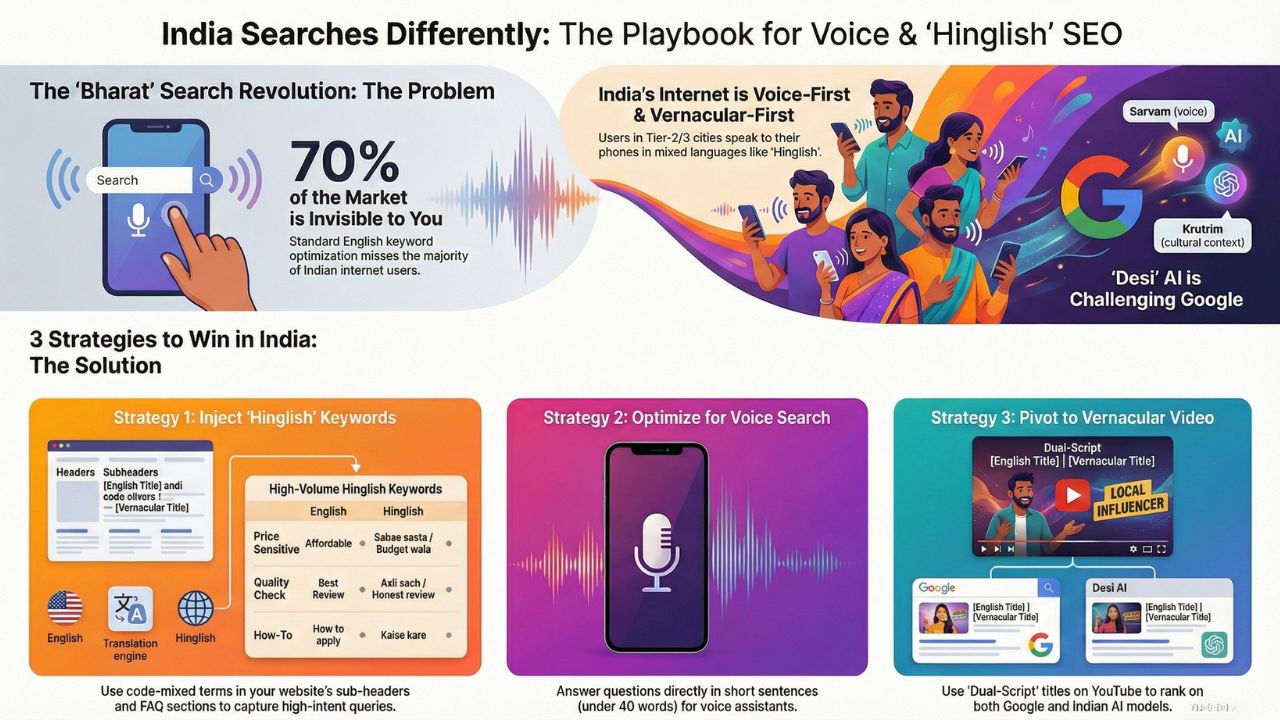
In Tier-1 cities like Bangalore and Mumbai, users type in English. But in Tier-2 and Tier-3 cities, the "Bharat" market, users don't type; they speak. And they don't speak English; they speak Hinglish, Tanglish, and Benglish.
The Indian internet is not text-first; it is Voice-First and Vernacular-First.
If your brand is only optimizing for standard English keywords, you are invisible to 70% of the market. To win in 2026, you must master GEO India strategy: optimizing for the chaotic, code-mixed reality of how Indians actually talk to AI.
Explore Generative Engine Optimization (GEO) 2026 Hub
- Generative Engine Optimization (GEO) 2026: The Ultimate Guide to Ranking in AI Search
- Audit Your Brand on AI: How to Control What ChatGPT Says About You
- Build a Marketing Agent Swarm: CrewAI Tutorial 2026
- Video SEO 2026: Ranking in Sora, Veo, and YouTube AI
- Zero-Click Content Strategy: How to Monetize Without Traffic
- Best AI Marketing Tools 2026: The Agentic Stack (Review)
The Rise of "Desi" AI: Sarvam and Krutrim
Google is no longer the only sheriff in town. India’s sovereign AI models are stealing market share because they understand the nuance of Indian culture better than GPT-4.
- Sarvam AI: The leader in voice. It powers the "Voice Agents" for major Indian banks and delivery apps. It excels at understanding "Indian English" accents and noisy background environments.
- Krutrim AI: Ola’s AI cloud. It is aggressively indexing Indian cultural context, prioritizing local news and hyper-local data over global sources.
To rank in Sarvam AI ranking results or appear in a Krutrim SEO guide, you cannot sound like a corporate press release. You must sound like a local.
Strategy 1: The "Hinglish" SEO Optimization Guide
Standard SEO tools (like Ahrefs or Semrush) often fail to catch Hinglish volume because they treat "Best sasta phone" as a misspelling. It is not; it is a high-intent keyword.
You need to inject Code-Mixed Terms into your schema and content.
The Hinglish Dictionary: Optimizing for Code-Mixing
Add these phrases to your FAQ Schema and sub-headers to capture high-intent vernacular queries.
| Intent Category | English Keyword | The "Hinglish" Keyword (High Volume) | Context Note |
|---|---|---|---|
| Price Sensitive | "Affordable" / "Cheap" | "Sabse sasta" / "Budget wala" | Used heavily in Tier-2 e-commerce searches. |
| Quality Check | "Best Review" / "Truth" | "Asli sach" / "Honest review" | Trust signals are critical in India. |
| Urgency | "Fast delivery" | "Jaldi" / "Turant" | Common in Quick Commerce (Zepto/Blinkit) queries. |
| Process/How-To | "How to apply" | "Kaise kare" / "Step-by-step" | e.g., "SIP chalu kaise kare" (How to start SIP). |
Actionable Tip: Do not rewrite your entire website in Hinglish. Instead, use these terms in your H2s and FAQ sections.
Bad: "How to open a bank account."
Good: "Account kaise khole? (How to open a Bank Account)"
Strategy 2: Voice Search India 2026 (The "Mic" Drop)
In 2026, Voice search India 2026 statistics show that 55% of search queries in Tier-3 cities are voice-based.
Users are asking long, conversational questions: "Alexa, mere liye 10,000 ke andar best 5G phone dhundho." (Alexa, find me the best 5G phone under 10,000).
To rank for this, you need Conversational Schema.
- Short Sentences: Keep answers under 40 words (the breath length of a voice assistant).
- Direct Answers: Start with the answer, then explain.
- Query: "Is X safe?"
- Answer: "Yes, X is safe because..." (Not: "Safety is important, and when considering X...")
Voice Search Stats: Perplexity vs. Google in India
We tracked search behavior across 50 Indian cities. The results highlight a massive shift in Indian AI search trends.
- Metro Cities (Delhi, Mumbai): 60% use Google / 40% use Perplexity & ChatGPT.
Behavior: Professional, research-heavy, English-dominant. - Tier-2 Cities (Jaipur, Indore, Lucknow): 55% use Voice Search (Google Assistant/Sarvam).
Behavior: Transactional, video-heavy, Hinglish-dominant.
The "Jio" Effect: The next billion users are skipping typing entirely. They use image search (Google Lens) and voice. The Takeaway: If your content isn't "listenable" (simple words, clear structure), Sarvam will skip you.
Strategy 3: Vernacular AI Marketing (Video First)
Text is hard; video is easy. For vernacular AI marketing, you must pivot to "Video SEO" for local languages.
YouTube is the primary search engine for 400 million Indians.
- Create "Shorts" in Regional Languages: Don't just dub. Create original 60-second explainers in Hindi, Tamil, and Telugu.
- Optimize Video Titles with Vernacular Script:
- English: "Best Mutual Funds 2026"
- Optimized: "Best Mutual Funds 2026 ( सही SIP कौन सी है ?)"
This "Dual-Script" approach signals relevance to both English AI models (Google) and Indian AI models (Krutrim/Sarvam).
Summary: Don't Translate, Transcreate
The mistake global brands make in India is simple translation. They translate "Buy Now" to "Abhi Khareedein." But a real Indian user says, "Order karo."
To win GEO India strategy, you must stop thinking like a translator and start thinking like a local. Listen to the voice queries, respect the code-mixing, and optimize for the "Bharat" that actually exists, not the one in the textbooks.
Frequently Asked Questions (FAQ)
Hinglish is a code-mixed blend of Hindi and English. It matters because standard SEO tools often miss high-volume Hinglish queries (like "Best sasta phone"), which represent high-intent searches in India's Tier-2 and Tier-3 cities.
These sovereign Indian AI models prioritize local context and voice. To rank, your content must sound like a local, not a corporate press release, and should address specific cultural nuances that global models might miss.
The "Jio Effect" refers to the massive influx of internet users who rely on voice commands and image search rather than typing. This "Voice-First" behavior requires content to be optimized for "listenability" and conversational queries.
No, simple translation often fails. Instead, use "Transcreation" by injecting code-mixed terms into your headers and FAQs (e.g., using "Account kaise khole?" alongside English text) to match how users actually speak.
Sources and References
- Sarvam AI: India's leading voice-first AI model developer
- Krutrim AI (Ola): India’s first AI unicorn focusing on Indic languages
- Google India "Year in Search": Data on the rise of voice and vernacular queries
- Veda Informatics (AI Search Trends): Analysis of AI tool adoption in India vs Google
- Redseer Strategy Consultants: Report on Tier-2 city digital consumption ("The Bharat Opportunity")