7 AI Agents You Can Build This Weekend
The "Chatbot Era" is over. For two years, we've focused on getting fast answers. Now, the new focus is agency.
We are moving from simply Chatting with AI to Managing AI Workforces, teams of specialized agents that execute complex, multi-step tasks autonomously. Whether you're an engineer in San Francisco focused on ROI, a CTO in London prioritizing GDPR compliance, or an architect in Bengaluru building local, sovereign tech, this is your blueprint.
The secret? Shifting from brittle, linear AI chains to the resilient, self-correcting cyclic graph AI architecture enabled by tools like Python LangGraph.
Here are 7 high-impact agentic workflow examples Python developers can build AI agents for this weekend.
Explore the Global AI Engineering Handbook
- Global AI Engineering Handbook 2026: Agentic Swarms & Sovereign AI
- Top 10 Open Source LLMs for 2026
- 5 AI Coding Assistants Better Than Copilot (2026)
- 8 Deep-Tech AI Startups Defining 2026 | Global vs Sovereign
- 12 AI Skills to Master in 2026: Systems Architect Roadmap
- 8 Indian AI Startups Hiring Aggressively in 2026
1. The "GDPR/DPDP" Compliance Sentinel
This is a critical use case for engineers in the EU and India. Instead of manual audits, deploy a specialized swarm to protect Personally Identifiable Information (PII).
- Agent A (The Scanner): Scans the database schema (e.g., PostgreSQL, MongoDB) to identify fields likely containing PII (names, emails, phone numbers).
- Agent B (The Jurist): Maps the identified PII fields to specific clauses in local data privacy laws (like EU GDPR or India's DPDP Act). This is your GDPR compliance AI agent.
- Agent C (The Coder): Drafts the necessary SQL or ORM patch script to apply the required masking or encryption policy (e.g., tokenization or hashing).
| Agent | Role | Technology |
|---|---|---|
| Agent A (The Scanner) | Scans new database schemas, identifying and tagging all potential Personally Identifiable Information (PII). | Database connectors (SQLAlchemy), NLP entity recognition tools. |
| Agent B (The Jurist) | Maps the PII types to local legal requirements (e.g., pseudonymisation under GDPR or masking under DPDP). | RAG pipeline using country-specific legal documents. |
| Agent C (The Coder) | Drafts the Python/SQL code necessary to enforce the data masking policy defined by Agent B. | Code generation LLM (e.g., Llama 4). |
2. The "Self-Healing" DevOps Swarm
The true power of agents is their ability to act on alerts, not just report them. This swarm connects directly to your incident management system.
- Agent A (The Sentinel): Reads a new alert from PagerDuty (or similar tool), extracts the error code and microservice name.
- Agent B (The Researcher): This agent is a Local RAG Pipeline specialist. It scrapes internal documentation, past Jira tickets, and external sites like StackOverflow to identify the root cause and a potential fix.
- Agent C (The Junior Dev): Writes a preliminary patch test script, or even a minimal fix, placing it in a draft Pull Request for a human to review.
This is the ultimate self-healing devops swarm.
| Agent | Role | Technology |
|---|---|---|
| Agent A (The Monitor) | Connects to PagerDuty API to read the latest critical alert, categorize it (e.g., Database Failure, OOM), and extract error codes. | Webhook integration, LLM for error code extraction. |
| Agent B (The Researcher) | Takes the error code and severity, then scrapes StackOverflow, GitHub Issues, and internal documentation for a known fix or root cause. | Web scraping tools, internal RAG pipeline. |
| Agent C (The Junior Dev) | Given Agent B's findings, it writes a short patch test script and the fix itself (e.g., a simple config file change or a quick database command). | Code generation model (e.g., Claude 3). |
3. The "Sovereign" Finance Auditor
For handling extremely sensitive documents in banking, legal, or government, data sovereignty is non-negotiable. This is a single-agent system, but its context is everything. It runs entirely on local, air-gapped infrastructure using small, optimized models like Quantized Llama 4.
The Auditor Agent: Processes sensitive bank PDF statements or legal contracts. It uses a local RAG pipeline for finance to answer complex queries (e.g., "Summarize all liabilities over $1M and flag any non-standard covenants") without sending a single byte to an external cloud API.
4. The "HR Recruiter" Army
Replace the most time-consuming steps of hiring with an autonomous recruiting agent that manages the candidate funnel from sourcing to initial outreach.
- Agent A (The Scraper): Monitors platforms like LinkedIn, Wellfound, or GitHub for passive candidates matching specific role keywords.
- Agent B (The Scorer): Takes a candidate resume and scores it against the official job description, identifying core skill gaps and fit based on the company's culture documents.
- Agent C (The Communicator): Drafts personalized outreach emails in the hiring manager's distinct voice and tone, ready for one-click approval and send.
| Agent | Task Description |
|---|---|
| Agent A (The Scraper) | Scrapes platforms like LinkedIn and Wellfound to find potential candidates. |
| Agent B (The Scorer) | Reads resumes and scores them against the specific job description to find the best fit. |
| Agent C (The Communicator) | Drafts personalized outreach emails in the hiring manager's specific voice and tone. |
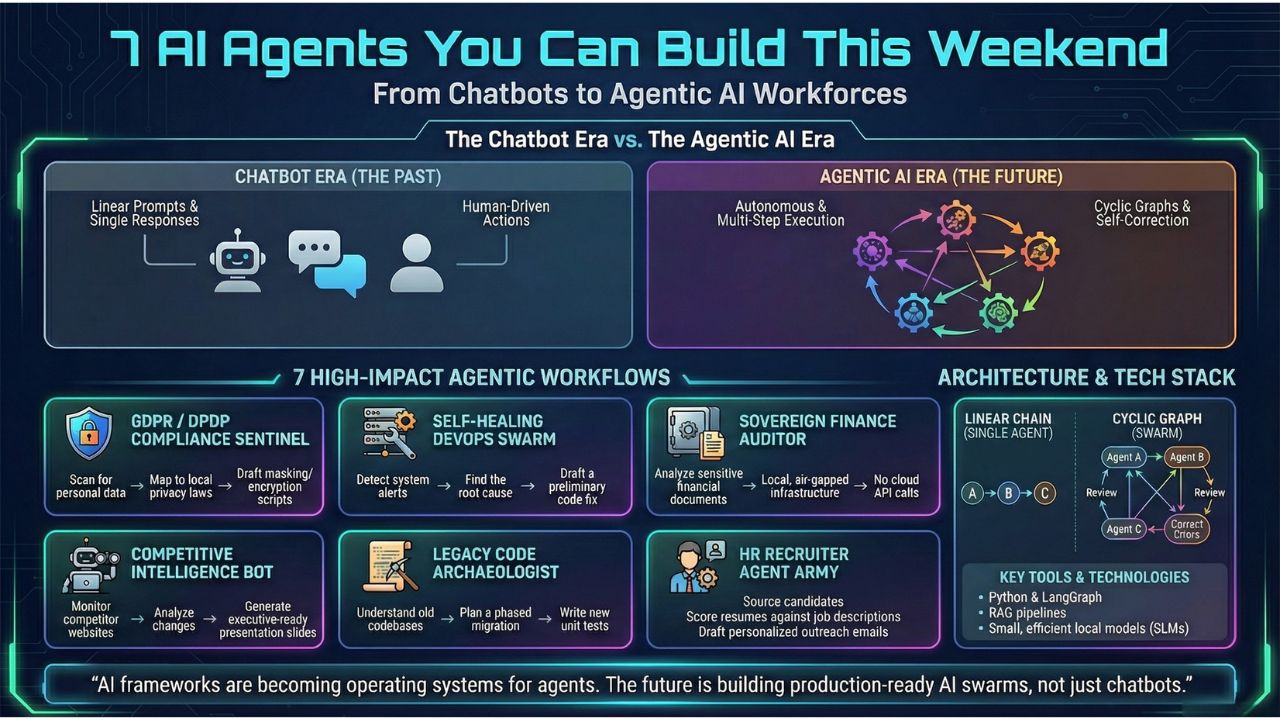
5. The Competitive Intel Bot
Turn market surveillance into an automated, executive-ready presentation.
- Agent A (The Monitor): Uses a web-scraping tool to monitor 5-10 competitor pricing and feature pages daily.
- Agent B (The Diff Engine/Analyst): Compares today's state with yesterday's baseline. It identifies and summarizes the material changes (e.g., a new product tier, a price increase).
- Agent C (The Executive/Strategist): Takes the summary from Agent B and generates a 3-slide "Strategy Update" deck in the CEO's preferred slide format (PowerPoint/Keynote) and tone.
| Agent | Task Description |
|---|---|
| Agent A (The Monitor) | Uses a web-scraping tool to monitor 5-10 competitor pricing and feature pages daily. |
| Agent B (The Analyst) | Compares today's state with yesterday's baseline to identify material changes. |
| Agent C (The Executive) | Takes the summary from Agent B and generates a 3-slide Strategy Update deck. |
6. The "Legacy Code" Archaeologist
A massive ROI generator for companies dealing with decades-old codebases.
The Archaeologist Swarm: Point it at a legacy codebase (e.g., COBOL, Fortran, or Python 2). It doesn't just explain what the code does; the swarm works together to:
- Map all data flows and dependencies.
- Generate a phased migration plan (e.g., "Migrate Modules A and C to Go, keep Module B in Python for now").
- Draft a full suite of passing unit tests for the current legacy system, then write the new unit tests for the target language (Python/Go).
7. The "Jira Triage" Officer
Automating the soul-crushing work of managing the support and feature ticket queue.
The Triage Officer Swarm: Watches the "New" column in Jira or GitHub Issues.
The Swarm's Logic:
- Merge Duplicates: Identifies tickets describing the same bug and merges them, leaving a single, high-priority ticket.
- Clarify Vague Tickets: Comments on tickets lacking detail, asking clarifying questions (e.g., "Please provide the OS and browser version") before assigning.
- Smart Assignment: Assigns clear tickets to the correct developer by querying git commit history to find the person who last touched the relevant file.
Start Building Your Swarms Today
These seven examples are just the beginning of multi-agent orchestration tutorial. The core shift for 2026 is seeing your AI framework as an operating system for agents, not just a call-and-response tool.
By focusing on tools like LangGraph and the principles of cyclic graph AI architecture, you can build AI agents Python LangGraph and start solving globally relevant, high-value enterprise problems this weekend. Choose an agent and start building!
Frequently Asked Questions (FAQs)
Think of an Agent as a single AI worker with one specific tool. A Swarm is a full team. It is a network of agents with distinct roles (like a "Researcher," "Reviewer," and "Coder") that communicate with each other to solve a complex problem. Swarms use "Cyclic Graphs" to loop back and self-correct their own errors.
Not necessarily. The 2026 trend is moving toward "Small Language Models" (SLMs). You can run capable models like Microsoft Phi-5 or Quantized Llama 4 on consumer hardware, such as a Mac Studio or even a Pixel phone.
No, it is essential for any industry that handles sensitive data. Sovereign AI ensures that your data processing happens on local infrastructure that you control, ensuring you strictly adhere to laws like GDPR (Europe) or the DPDP Act (India).
Because you cannot ship what you cannot measure. As agents become more autonomous, you need automated "Evals" to grade their work and prevent hallucinations before they reach production.
Sources & References
Core Strategy:
Swarm Architecture:
Model Stack:
- Llama 4 (The Standard)
- Sarvam-3 (The Indic Specialist)
- Mistral AI (The leader in EU sovereign infrastructure)
Tooling:
Career Skills: