Top 10 Open Source LLMs for 2026
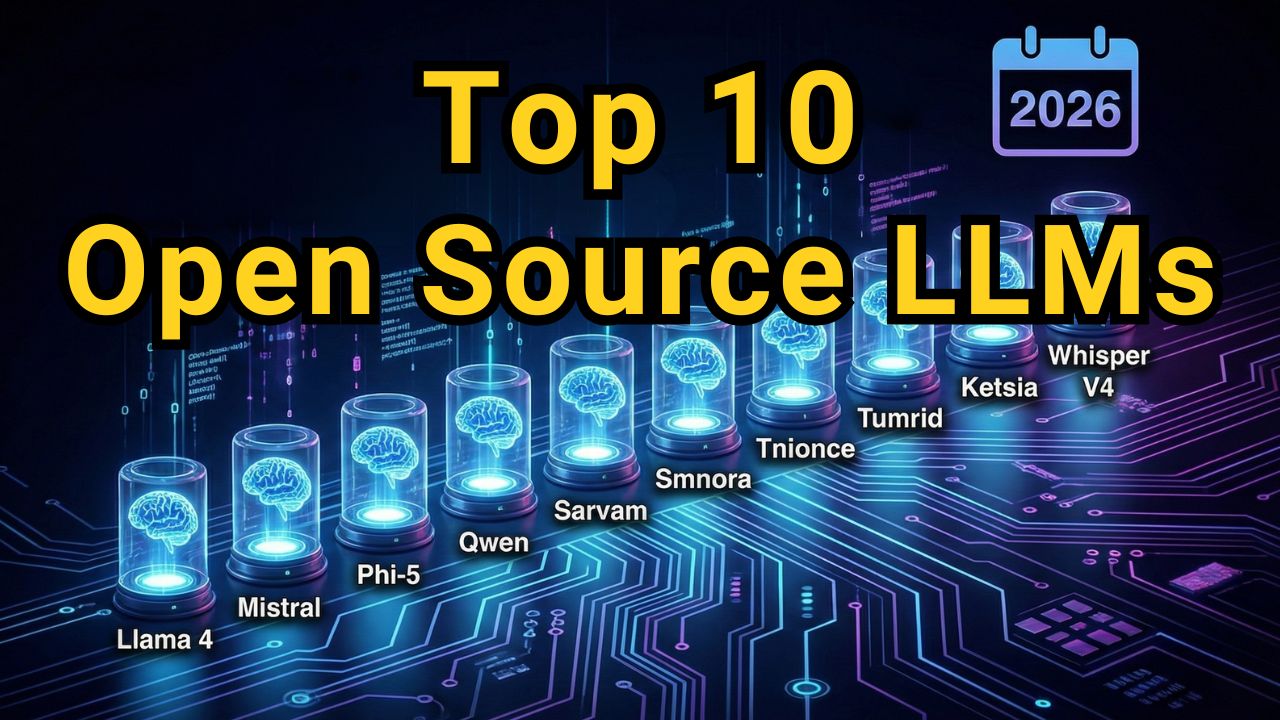
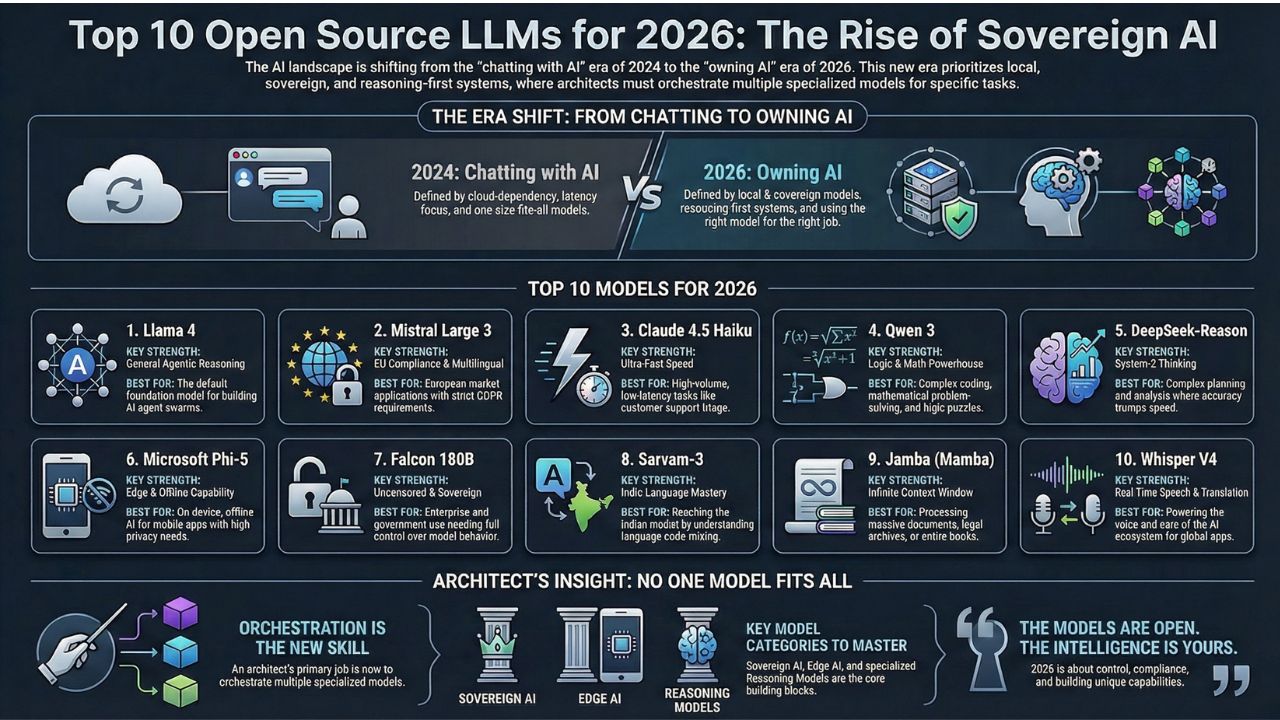
If 2024 was the year of "chatting" with AI, 2026 is the year of owning it.
For AI Architects today, the goal isn't just finding a smart model. It is about finding a model that is efficient, compliant, and capable of genuine reasoning. We are no longer renting intelligence; we are building "Sovereign AI" that runs on our own terms, whether that’s on a massive server in Mumbai or an iPhone in your pocket.
In this guide, we break down the top 10 models defining the landscape this year. Whether you need the best open source LLM 2026 has to offer or a specialized tool for coding, this list is your blueprint.
Explore the Global AI Engineering Handbook
- Global AI Engineering Handbook 2026: Agentic Swarms & Sovereign AI
- 7 AI Agents You Can Build This Weekend
- 5 AI Coding Assistants Better Than Copilot (2026)
- 8 Deep-Tech AI Startups Defining 2026 | Global vs Sovereign
- 12 AI Skills to Master in 2026: Systems Architect Roadmap
- 8 Indian AI Startups Hiring Aggressively in 2026
1. Llama 4 (The Standard)
Best For: General Agentic Reasoning & Foundation Work
If you are building an AI agent in 2026, you start here. Llama 4 has solidified itself as the default operating system for open-source intelligence.
Unlike its predecessors, which were good at talking, Llama 4 excels at doing. It is the engine of choice for "Agentic Swarms", teams of AI agents that work together to solve problems. Its ability to follow complex multi-step instructions makes it the backbone of modern software architecture.
Why it wins: It strikes the perfect balance between power and manageability.
Architect’s Note: Perfect for when you need to run LLM locally Mac Studio setups for development before deploying to the cloud.
2. Mistral "Large 3" (The European Titan)
Best For: Multilingual Compliance (EU) & nuances
When data privacy laws like GDPR are your top concern, you turn to Mistral. Hailing from France, Mistral Large 3 is the undisputed king of European languages. It doesn’t just translate; it understands cultural nuance in English, French, German, and Spanish better than any US-centric model.
The Rivalry: In the battle of Llama 4 vs Mistral Large 3, Mistral wins on compliance and multilingual fluency, while Llama takes the crown for raw reasoning speed.
3. Claude 4.5 Haiku (The Speed Demon)
Best For: High-Volume, Low-Latency Tasks
Note: While often accessed via API, its efficiency makes it a staple in the architect's hybrid toolkit.
Speed is currency. Claude 4.5 Haiku is designed for the "Chatbot Era" metric: latency. It is the fastest, cheapest model for tasks that need to happen instantly, like customer support triage or real-time data categorization.
It sacrifices deep philosophical reasoning for blazing-fast answers.
4. Qwen 3 (The Math Wizard)
Best For: Coding, Logic, and Complex Math
If your problem involves code, logic puzzles, or heavy mathematics, Qwen 3 is unbeatable. It has consistently outperformed larger models on coding benchmarks.
Developers love it because it acts like a senior engineer paired with you, spotting bugs and suggesting optimizations that actually work.
5. DeepSeek-Reason (System 2 Thinking)
Best For: Architectural Planning & "Thinking Before Speaking"
Most models react instantly. DeepSeek-Reason pauses. It uses "System 2" thinking (similar to how humans solve complex riddles) to think through a problem before generating an answer.
Use Case: DeepSeek Reason model use cases include complex legal contract review, architectural blueprint analysis, and medical diagnosis support where accuracy is far more important than speed.
6. Microsoft Phi-5 (The Edge King)
Best For: Mobile Devices & Offline AI
The future is local. Microsoft Phi-5 is a marvel of engineering, a "Small Language Model" (SLM) capable of running natively on consumer hardware like the iPhone 17 or Pixel 10 without an internet connection.
The Edge: This is true Microsoft Phi-5 Edge AI. It allows apps to be smart even in "airplane mode," ensuring total privacy since data never leaves the user's device.
7. Falcon 180B "Sovereign"
Best For: Uncensored Enterprise Use
Built in the Middle East, Falcon 180B is a powerhouse for organizations that need raw, unfiltered power. It is fully open and "uncensored," meaning it doesn't have the heavy-handed safety filters that some US models impose.
Why it matters: It is a top choice for sovereign AI models for banking and government sectors where institutions need full control over the model's behavior and bias.
8. Sarvam-3 (The Indic Specialist)
Best For: India & Code-Mixing (Hinglish/Tanglish)
For the Indian market, Sarvam-3 is a game-changer. Standard models struggle when users mix languages (like speaking Hindi and English in the same sentence). Sarvam-3 was trained specifically for this "code-mixing."
Local Hero: As a Sarvam AI Indic model, it unlocks access for millions of users by understanding the vernacular reality of how India speaks, making it essential for local fintech and govern-tech apps.
9. Jamba (Mamba Architecture)
Best For: Massive Documents & Infinite Context
Jamba breaks the mold. It doesn't use the standard "Transformer" architecture; it uses "Mamba." This allows it to have an effectively infinite context length. You can feed it entire books, legal archives, or years of financial logs, and it will process them in milliseconds.
It reads what others can't fit in memory.
10. Whisper V4 (The Universal Ear)
Best For: Real-Time Speech Translation
While strictly an audio model, Whisper V4 is the mouth and ears of the AI ecosystem. It provides near-perfect real-time translation for over 100 languages. It is the bridge that allows a rural farmer speaking Tamil to interact seamlessly with a banking bot built in English.
The Verdict for 2026
The era of "one model to rule them all" is over. The job of the AI Architect in 2026 is orchestration, choosing the right tool for the job.
- Need to run a private finance bot? Look at Falcon or quantized LLM performance on local hardware.
- Building for the next billion users in India? Sarvam-3 is your only choice.
- Need a coding assistant? Qwen 3 is your partner.
The models are here. The code is open. The only question left is: What will you build?
Frequently Asked Questions (FAQs)
Not necessarily. The industry trend is shifting toward "Small Language Models" (SLMs). Models like Microsoft Phi-5 or Quantized versions of Llama 4 are designed to run on consumer hardware, such as a Mac Studio or even a Pixel phone, without requiring massive server racks.
No, it is essential for any industry that handles sensitive data. "Sovereign AI" simply means that the data processing happens on local infrastructure that you control. This is critical for banks, hospitals, and legal firms that must adhere to strict laws like the EU's GDPR or India's DPDP Act.
An "Agent" is a single AI instance performing a task. A "Swarm" is a network of specialized agents (e.g., a "Researcher," a "Reviewer," and a "Coder") that collaborate to solve complex problems, often checking each other's work to reduce errors.