8 Deep-Tech AI Startups Defining 2026: The Global vs. Sovereign Race
The era of "AI Wrappers" is officially over.
In 2024, the market was flooded with companies building thin applications on top of ChatGPT. They were useful, but they were fragile. But as we move into 2026, the real value has shifted.
We are no longer looking for apps; we are looking for Foundational IP.
The landscape has split into two distinct battlegrounds. On one side, we have the Global Disruptors in the West, pushing the boundaries of how AI thinks and behaves. On the other, we have India's Sovereign Stars, who are building the critical infrastructure to make AI independent, secure, and accessible to billions.
If you are tracking deep tech AI investment trends, these are the 8 companies that are not just participating in the future, they are building it.
Explore the Global AI Engineering Handbook
Part 1: Global Disruptors (US/UK/EU)
The giants defining safety, efficiency, and action.
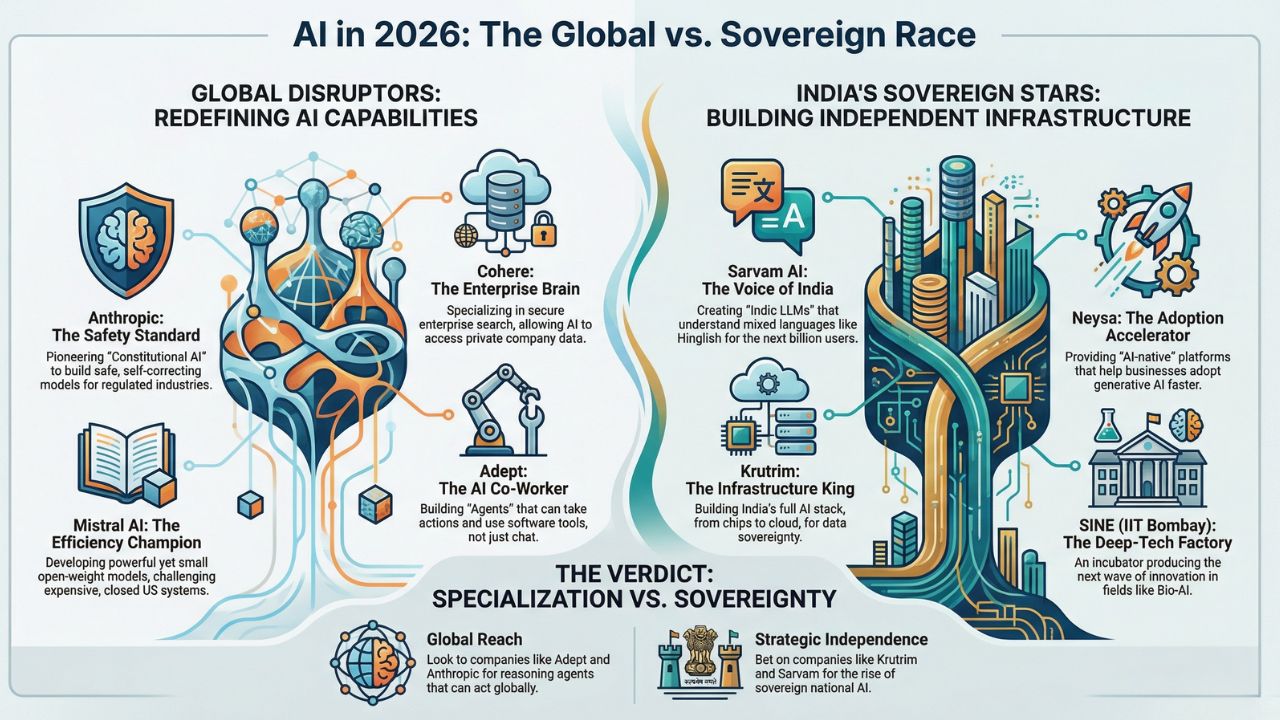
1. Anthropic (USA): The Safety Standard
While other labs race to build the smartest model, Anthropic is racing to build the safest. They are the pioneers of "Constitutional AI".
The Tech: Instead of manually filtering bad answers, they teach their AI a "constitution", a set of values it must follow. It learns to self-correct, effectively having a conscience.
Why it Matters: As banks and hospitals adopt AI, they can't risk a chatbot going rogue. Anthropic is becoming the default choice for highly regulated industries where safety is the number one priority.
2. Mistral AI (France): The European Efficiency Champion
Mistral shattered the myth that you need a trillion dollars to build a world-class model. They are the champions of "Open Weight" models and European sovereignty.
The Tech: Their models are shockingly small but powerful, often outperforming massive US models on logic tasks while running on much cheaper hardware.
The Big Debate: In the Anthropic vs Mistral AI discussion, investors see a clear split: Anthropic is the "Apple" (closed, safe, polished), while Mistral is the "Android" (open, flexible, and everywhere).
3. Cohere (Canada): The Enterprise Brain
Cohere isn't trying to write poetry or generate funny images. They are laser-focused on one thing: Enterprise Search.
The Tech: They specialize in "RAG" (Retrieval-Augmented Generation). This technology allows a company to securely connect an AI to its own private emails, documents, and databases.
Why it Matters: For a Fortune 500 company, the value isn't in a chatbot that knows world history; it's in a chatbot that knows company history. Cohere makes that possible without leaking data.
4. Adept (USA): The AI Co-Worker
Most AIs today are "Chatbots", they just talk. Adept is building "Agents."
The Tech: Adept AI agents are designed to use existing software tools like a human does. They can open a browser, log into Salesforce, click buttons, copy data into Excel, and send an email.
The Vision: They aren't replacing the writer; they are replacing the repetitive "click-work" that takes up 50% of an office worker's day.
Part 2: India's Rising Stars (The "Sovereign" Angle)
The "Desi AI Revolution" building independent infrastructure.
5. Sarvam AI: The Voice of India
India has 22 official languages, and Silicon Valley models struggle with most of them. Sarvam AI is building "Indic LLMs" from the ground up to solve this.
The Tech: Their models excel at "Code-Mixing", the natural way Indians speak by blending English with Hindi, Tamil, or Telugu.
Investment Note: Recent Sarvam AI funding rounds highlight a massive market gap: bringing Generative AI to the next billion users who don't interact in perfect English.
6. Krutrim (Ola): The Infrastructure King
You can't have "Sovereign AI" if your data lives on a server in Oregon. Krutrim AI cloud infrastructure is India’s answer to AWS.
The Tech: They are building the full stack, from the silicon chips that process the data to the cloud platforms that host it.
Why it Matters: For Indian banks and government agencies, keeping data within national borders is a legal requirement. Krutrim provides the "Sovereign Silicon" to make that possible.
7. Neysa: The Accelerator
While Krutrim builds the hardware, Neysa builds the bridge.
The Tech: Neysa provides "AI-native" cloud platforms designed to help companies adopt GenAI faster.
The Problem: Most companies want to use AI but don't know how to set up the complex infrastructure. Neysa acts as the accelerator, handling the heavy lifting so businesses can focus on the application.
8. SINE (IIT Bombay) Ventures: The Stealth Factory
This isn't a single startup, but the incubator to watch. SINE at IIT Bombay is the birthplace of India's deep-tech innovation.
What to Watch: Keep an eye out here for stealth startups working on Bio-AI (using AI to discover new drugs) and Material Science. These sectors are poised to be the next big wave of investment after the LLM hype settles.
The Verdict: Who Wins in 2026?
The market is no longer just about who has the smartest chatbot. It is about specialization and sovereignty.
- For Global Reach: If you want reasoning agents that can act on your behalf, look at Adept and Anthropic.
- For Strategic Independence: If you are betting on the rise of sovereign AI companies India, look at Krutrim and Sarvam.
The top artificial intelligence startups 2026 are not just coding apps; they are building the digital roads and bridges for the next decade of software.
Frequently Asked Questions (FAQs)
Sovereign AI means a country or company owns its own AI infrastructure, including the servers, the models, and the data, rather than relying on foreign tech giants. This ensures data privacy and independence.
Most AI models are trained primarily on English data. Sarvam AI focuses on Indian languages and cultural contexts, making AI useful for the billions of people who speak mixed languages (like Hinglish) or regional dialects.
Adept is building "Agents," not just chatbots. While ChatGPT gives you a text answer, Adept's AI can actually take control of your mouse and keyboard to perform multi-step tasks in software like Excel, Salesforce, or Photoshop.