Automating Customer Support: AI Chatbots vs. Virtual Assistants
Are you still answering customer emails at 11 PM? For the modern solopreneur, customer support is a double-edged sword. You need to treat your customers like royalty to grow, but every hour spent resolving support tickets is an hour taken away from building your product or marketing your brand.
As noted in The AI Solopreneur hub, customer support can quickly "drain your creative energy". If you want to transition from a burnt-out freelancer to a "Zero-Employee Enterprise," you need to automate.
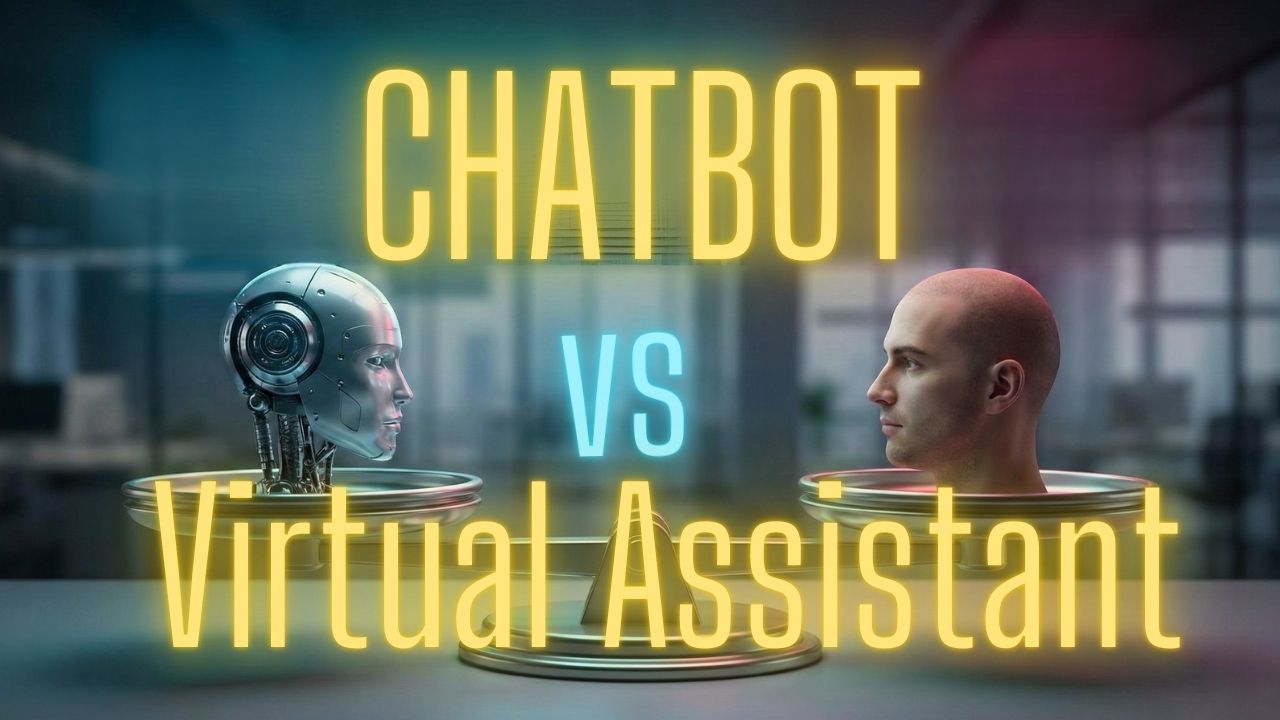
But what is the best route: hiring a human Virtual Assistant (VA) or deploying a smart AI Chatbot? This article battles it out to help you decide.
Explore the AI Solopreneur Hub
- The AI Solopreneur: Guide to One-Person Enterprise
- Best AI CRM Tools for Solopreneurs: Salesforce vs. HubSpot AI
- Top 10 AI Agents That Replace Marketing Agencies in 2026
- AI Bookkeeping: Automate Your Business Taxes
- Best Business Credit Cards for AI Startups
- Using Predictive AI for Stock Market Analysis
- Cybersecurity for Solopreneurs: Protecting Data from Deepfakes
- Cloud Hosting for AI: GPU vs. CPU Servers
- Do You Need Business Insurance for an AI Agency?
- How to Build a $10k/Month Business with $0 Upfront Cost
- Case Study: I Let AI Run My Dropshipping Store for 30 Days
- The Death of 9-5: Agentic AI & The Solopreneur Boom
The Contenders: Empathy vs. Efficiency
Before we look at the price tag, let's look at the players.
1. The Human Virtual Assistant (VA)
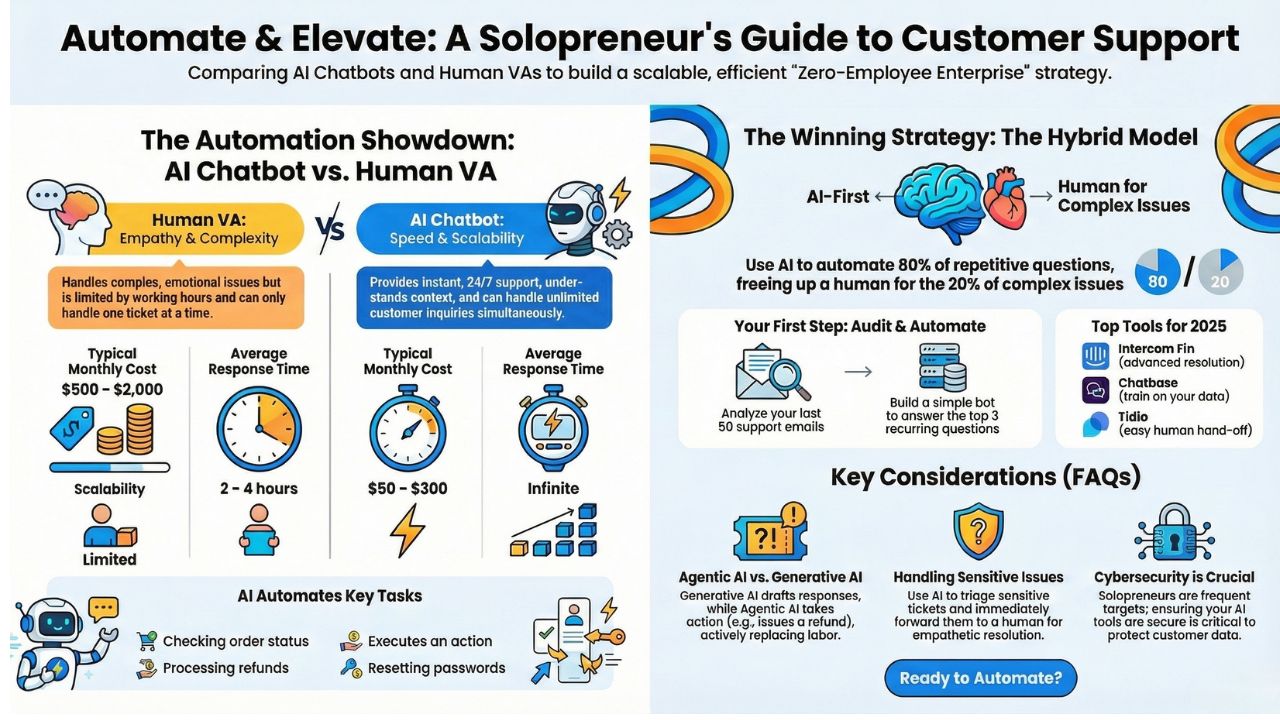
A human VA is versatile. They can handle complex, emotional issues that require a personal touch. However, they sleep, they take weekends off, and they can only handle one ticket at a time.
2. The AI Chatbot (NLP-Driven)
We aren't talking about the "dumb" bots of 2015. We are talking about natural language processing chatbots for customer support. These agents understand context, can reset passwords instantly, and don't care if it's 3 AM on a Sunday.
Round 1: The Cost Breakdown
For a bootstrapped business, cash flow is king. This is where the difference becomes massive.
- The Human Cost: A reliable VA might cost you anywhere from $500 to $2,000 per month depending on their location and skill level.
- The AI Cost: Most customer service helpdesk software reviews place AI tools in the range of $50 to $300 per month for unlimited 24/7 support.
When you calculate the AI chatbot vs Human Virtual Assistant cost, the AI wins on pure margins. You pay a flat software subscription fee rather than a variable hourly wage.
Key Takeaway: AI tools scale. A human VA gets overwhelmed if 100 customers email at once. An AI doesn't blink.
Round 2: Performance and Speed
Your customers expect instant answers. If you integrate AI customer service tools correctly, you can achieve "zero wait time." A human VA might take 2-4 hours to respond. An AI agent responds in milliseconds.
The goal isn't just to answer questions; it is to solve problems. The best automated ticketing system for small business can now perform actions, like checking order status or processing refunds, without you ever clicking a button.
The Result? You can reduce customer support costs with automation while actually increasing customer satisfaction because they get their answers faster.
Round 3: The Best Tools for 2025
Ready to build your stack? Here are the top contenders for the best conversational ai platforms for websites that you should look at:
- Intercom Fin: A heavy hitter that uses advanced AI to resolve tickets automatically.
- Chatbase: Perfect for solopreneurs. You upload your PDF documents/website data, and it trains a bot to answer questions based only on your data.
- Tidio: Great for combining simple chatbots with human hand-off when things get too complex.
The Verdict: The Hybrid Model
Who wins the battle? For the "AI Solopreneur," the winner is the AI-First approach. You should aim to reduce support tickets by up to 80% using AI.
The AI handles the repetitive questions ("Where is my order?", "How do I reset my password?"). Then, and only then, do you bring in a human (or yourself) to handle the remaining 20% of complex issues. This keeps your team small and your profits high.
Ready to Automate?
Don't try to automate everything at once. Start by auditing your last 50 emails. Identify the top 3 recurring questions and configure a simple chatbot to answer just those three.
Frequently Asked Questions (FAQs)
Initial costs can be surprisingly low. Many tools offer free tiers to start. However, scaling requires a budget for software subscriptions (SaaS) and API fees, but this investment replaces traditional payroll costs, saving you money in the long run.
AI is excellent for 80% of repetitive queries (like "Where is my order?"). However, for highly sensitive or complex issues, a "human-in-the-loop" approach is best. Use AI to triage the ticket, then forward it to you if it requires empathy.
Generative AI creates content (like drafting an email response). Agentic AI performs actions (like actually sending that email or booking a meeting). For customer support, you want Agentic AI because it actively replaces human labor rather than just assisting it.
Solopreneurs are common targets for cyberattacks because they often lack the security infrastructure of large corporations. Automated attacks do not discriminate by company size, so ensuring your AI tools are secure is critical.
Sources and References
Financial & Market Data:
- Google Cloud AI Trends Report (2025) - Data on enterprise AI adoption.
- Agentic AI with AI Agents – Transforming Automation’s New Era
- AI Adoption Statistics in 2025
Security Guidelines:
- Federal Trade Commission (FTC) Cybersecurity Guide for Small Business - Compliance standards.
- Federal Communications Commission (FCC) Cyber Planner - Security planning tools.
Software Reviews: