How to Build a $10k/Month Business with $0 Upfront Cost?

Can you really start a business with an empty bank account?
In the past, the answer was "no." You needed thousands of dollars for inventory, office rent, and employees. If you didn't have investors, you didn't have a startup. But in 2025, the rules have changed completely. The traditional agency model is dead, and the "Solopreneur" is no longer a small player but a high-efficiency enterprise.
The rise of the "AI Solopreneur" means you can now launch a fully automated, high-revenue company using nothing but a laptop and free software. This guide reveals the zero capital startup strategy that founders are using to build $10k/month businesses without spending a single dollar on day one.
Explore the AI Solopreneur Hub
- The AI Solopreneur: Guide to One-Person Enterprise
- Top 10 AI Agents That Replace Marketing Agencies in 2026
- Best AI CRM Tools for Solopreneurs: Salesforce vs. HubSpot AI
- AI Chatbots vs. Virtual Assistants: The Support Battle
- AI Bookkeeping: Automate Your Business Taxes
- Best Business Credit Cards for AI Startups
- Using Predictive AI for Stock Market Analysis
- Cybersecurity for Solopreneurs: Protecting Data from Deepfakes
- Cloud Hosting for AI: GPU vs. CPU Servers
- Do You Need Business Insurance for an AI Agency?
- Case Study: I Let AI Run My Dropshipping Store for 30 Days
- The Death of 9-5: Agentic AI & The Solopreneur Boom
The "Zero Capital" Mindset
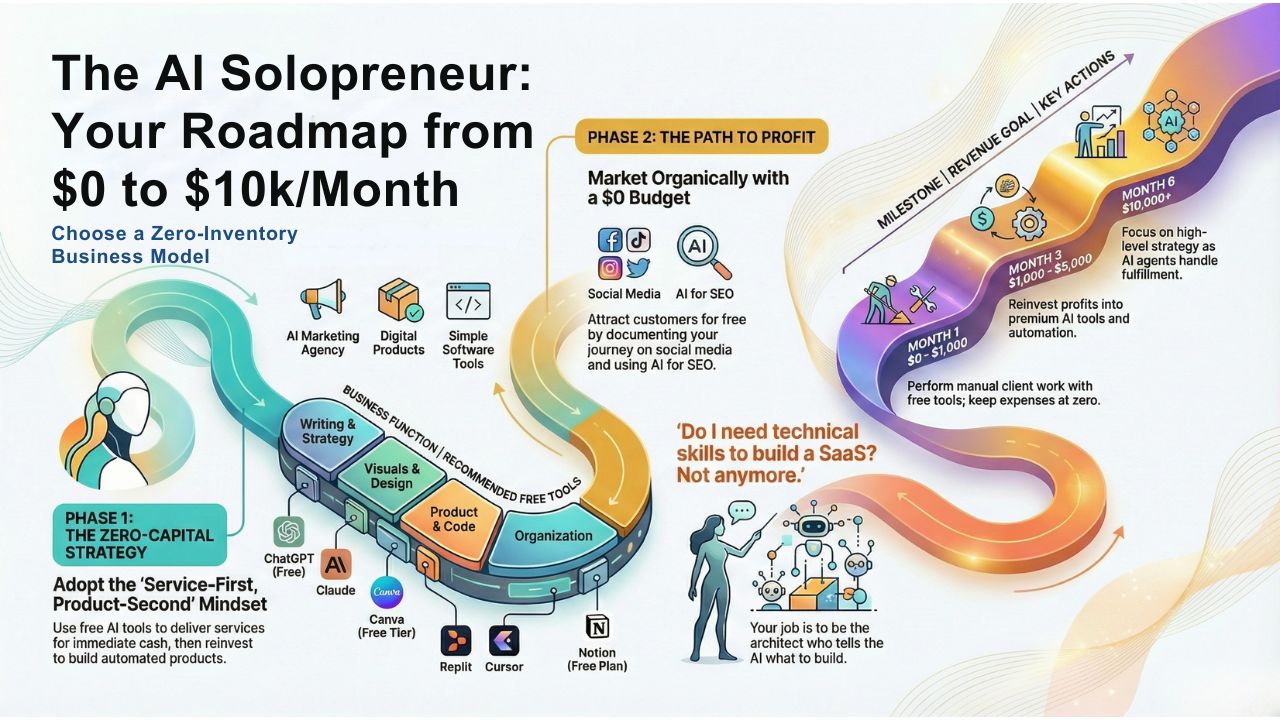
The traditional startup model is broken. You don't need venture capital; you need ingenuity. If you are wondering how to start a business with no money using AI, the secret lies in a strategy called "Service-First, Product-Second."
- Service-First: You use free AI tools to do work for clients (like writing copy or designing logos) to generate immediate cash.
- Product-Second: You use that cash to build automated tools that generate passive income ideas with artificial intelligence.
This is the ultimate form of bootstrapping a SaaS business guide: selling the solution before you even pay for the software.
Phase 1: Finding Your "Zero Cost" Idea
To succeed with no money, you must choose a business model that requires no physical inventory. Shipping boxes costs money; sending pixels is free. Here are the best low cost high profit business ideas for 2026:
1. The AI Marketing Agency (Service)
Marketing is the most expensive line item for most startups, and they are desperate to cut costs.
- The Idea: You become a "content machine." You offer to write 30 days of social media posts or 10 blog articles for a flat fee.
- The Zero Cost Trick: You don't write them yourself. You use free AI tools for entrepreneurs to generate the drafts, then you spend your time editing and polishing them.
2. Digital Products (Passive)
Once you create a digital file, you can sell it a million times without spending an extra penny.
- The Idea: Sell specialized prompts for ChatGPT, resume templates, or "How-To" ebooks.
- The Zero Cost Trick: You ask an AI to write the ebook or design the template for you. Your only cost is your time.
3. Micro-SaaS (Software)
- The Idea: Build a very simple software tool (like a "PDF to Excel Converter" or a specific "Mortgage Calculator").
- The Zero Cost Trick: You use AI coding assistants to write the code for you, even if you are not a developer.
These are scalable solopreneur business models because they have virtually 100% profit margins.
Phase 2: The "Free Tier" Tech Stack
You don't need expensive monthly subscriptions to start. The secret to the zero capital startup strategy is leveraging the "Free Tier" of powerful software. You can run your entire "Zero-Employee Enterprise" using this stack:
- For Strategy & Writing: ChatGPT (Free Version) or Claude. Use these to write your business plan, website copy, sales emails, and client deliverables.
- For Visuals & Design: Canva (Free Tier). Use this to create your logo, social media graphics, and pitch decks without hiring a designer.
- For Building Your Product: Replit or Cursor. These platforms allow you to generate code for apps and websites using natural language instructions.
- For Organization: Notion (Free Personal Plan). This acts as your headquarters to track tasks, client notes, and ideas.
By stacking these free tiers, you remove the barrier to entry. You only upgrade to paid versions after your first customer pays you.
Phase 3: Organic Marketing (Getting Traffic for Free)
You have a product. Now you need customers. Since you have a $0 budget, you cannot buy Facebook or Google Ads. You must use viral organic strategies to grow.
- Document, Don't Create: Post 3x a day on TikTok, YouTube Shorts, or LinkedIn documenting your journey. "I am building a business from scratch using AI, follow along." This "Building in Public" style is highly engaging.
- AI-Generated SEO: Use AI to write helpful articles (like this one) that answer specific questions. Over time, these articles rank on Google and bring you free traffic.
- Cold Outreach: Use AI to draft personalized emails to potential clients. It costs nothing to send an email.
This traffic drives users to your passive income ideas with artificial intelligence, converting viewers into buyers without ad spend.
The Roadmap: From $0 to $10k
This isn't magic; it's math. Here is the typical path for a "Zero-Employee Enterprise":
- Month 1 ($0 - $1,000): You hustle. You use free AI tools to do manual work for a few clients. You have zero expenses.
- Month 3 ($1,000 - $5,000): You reinvest your profit. You buy a better website domain, pay for premium AI tools (like Midjourney or GPT-4), and automate your social media.
- Month 6 ($10,000+): You have built a library of digital products or a recurring service. Your AI agents handle the fulfillment, and you focus on strategy.
Frequently Asked Questions (FAQs)
Yes. If you already have a computer and internet, you have everything you need. Initial costs can be low because many tools offer free tiers. You can earn your first paycheck using only free software.
This is not a "get rich quick" scheme. While some viral success stories happen overnight, most solopreneurs take 6 to 12 months of consistent effort to build the audience and product library required to hit $10k/month.
Not anymore. Generative AI creates content, but Agentic AI performs actions, including coding apps. Your job is to be the "architect" who tells the AI what to build, not the engineer who types the code.
Use AI to find them. Ask ChatGPT: "Analyze the top complaints on Reddit about [Topic X] and suggest 3 software solutions I could build to fix them."