The Death of the 9-5: Why Agentic AI is Creating a Solopreneur Boom
The traditional 9-to-5 job is dying. It isn't just sick; it is on life support. For decades, the "safe" path was simple: get a university degree, join a big corporation, work 40 hours a week, and slowly climb the ladder until you retire. But in 2025 and moving into 2026, the ladder is broken.
We are witnessing a historic macroeconomic shift away from employment toward solopreneurship. The "AI Solopreneur" is not just a freelancer or a gig worker. They are the CEO of a digital workforce, capable of operating with the output of a 50-person team but the overhead of just one person. This article explores the critical future of work trends 2026 and explains why the ability to manage AI agents is becoming the most valuable skill of the decade.
Explore the AI Solopreneur Hub
- The AI Solopreneur: Guide to One-Person Enterprise
- Top 10 AI Agents That Replace Marketing Agencies in 2026
- Best AI CRM Tools for Solopreneurs: Salesforce vs. HubSpot AI
- AI Chatbots vs. Virtual Assistants: The Support Battle
- Best Business Credit Cards for AI Startups
- AI Bookkeeping: Automate Your Business Taxes
- Using Predictive AI for Stock Market Analysis
- Cybersecurity for Solopreneurs: Protecting Data from Deepfakes
- Cloud Hosting for AI: GPU vs. CPU Servers
- Do You Need Business Insurance for an AI Agency?
- How to Build a $10k/Month Business with $0 Upfront Cost
- Case Study: I Let AI Run My Dropshipping Store for 30 Days
The Great Shift: From Employee to Owner
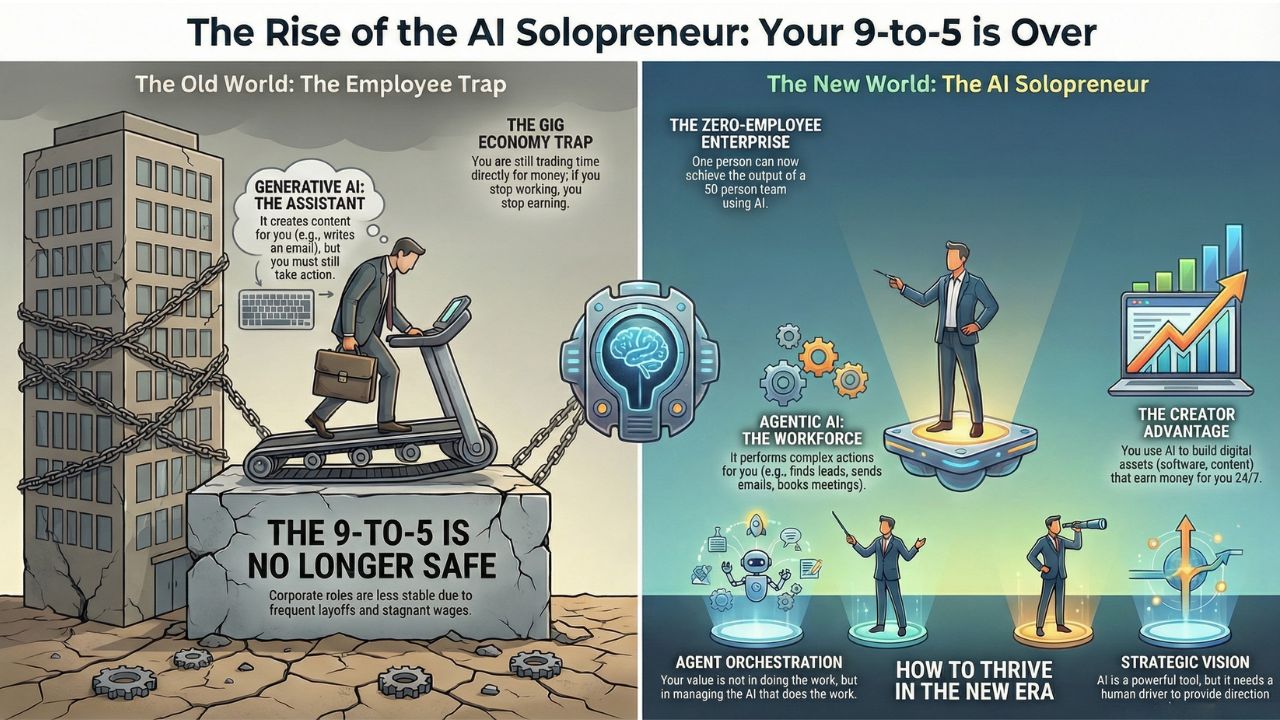
Why is everyone leaving their jobs? The transition from employee to solopreneur is being driven by a simple realization: employment is no longer safe. In the past, companies offered stability. Today, layoffs are common, and wages are stagnant.
However, the impact of agentic AI on employment is providing a new exit door.
- Displacement: AI is automating mid-level tasks like coding, copywriting, and data analysis. This makes traditional corporate roles less stable.
- Empowerment: The same AI that threatens jobs also empowers individuals. It allows one person to build a business that used to require a million dollars in funding.
We are entering the era of the "Zero-Employee Enterprise," where your "staff" consists of software, not people.
Agentic AI: The Engine of Change
To understand this boom, you must understand the technology driving it. We are moving beyond "Generative AI" (which just creates text or images) to "Agentic AI."
- Generative AI: You ask ChatGPT to write an email. It writes it. You still have to send it.
- Agentic AI: You tell an AI agent to "find leads, write them emails, and book meetings." The agent performs the actions for you.
This distinction is crucial. Agentic AI actively replaces human labor. This allows a solopreneur to automate complex loops, like running a dropshipping store or managing a marketing campaign, without constant intervention.
Gig Economy vs. Creator Economy Growth
We are moving past the "Gig Economy" (driving for Uber, delivering food, trading time for money). The real story in 2026 is the gig economy vs creator economy growth.
- The Gig Trap: In the gig economy, if you stop working, you stop getting paid. You are still an employee; you just have a different boss (an app).
- The Creator Advantage: In the AI-powered creator economy, you own the assets. You use AI to build software, write books, or create content hubs. These assets pay you while you sleep.
AI facilitates this shift by handling the "boring" parts of creation (video editing, scheduling, formatting), allowing you to focus purely on the creative strategy.
The Rise of the One-Person Unicorn
Investors used to laugh at the idea of a billion-dollar company with no employees. They aren't laughing anymore. We are seeing the rise of the one-person unicorn company. These are hyper-efficient startups that reach massive valuations with only one full-time human founder.
How autonomous agents change business models:
- Marketing: Instead of hiring a VP of Marketing ($200k/year), the founder deploys a cluster of AI marketing agents ($200/month).
- Sales: Instead of a sales team, they use AI CRMs to score leads automatically.
- Operations: Instead of an admin, they use automation tools to handle taxes and bookkeeping.
This massive reduction in overhead means the founder keeps the profit, rather than spending it on payroll.
Essential Skills for the AI Era
If you want to survive this shift, you cannot just "learn to code." AI can code better and faster than you can. The essential skills for the AI era are managerial, not technical:
- Agent Orchestration: You need to know how to "chain" different AI tools together. You must be the conductor of the orchestra, ensuring the writing AI talks to the image AI, which talks to the website AI.
- Strategic Vision: AI is a Ferrari; it needs a driver. It can go fast, but it doesn't know where to go. Your job is to set the destination.
- Cognitive Security: As a public-facing founder, you must know how to protect your digital identity from deepfakes and cyberattacks.
Frequently Asked Questions (FAQs)
No, but it will replace tasks. The future of work trends 2026 suggest that roles will shift from "doing the work" to "managing the AI that does the work". The humans who thrive will be those who can manage AI agents.
It is risky, but staying in a dying corporate model is also risky. The "Solopreneur" model offers diversification, if you lose one client or revenue stream, you don't lose your entire income.
Generative AI creates content (text, images). Agentic AI performs actions (sending emails, booking meetings, coding apps). This hub focuses on Agentic AI because it actively replaces human labor.