Case Study: I Let AI Run My Dropshipping Store for 30 Days
Is dropshipping dead? Or does it just need a brain transplant?
For years, gurus have asked, "Is dropshipping still profitable in 2025?". The answer is usually "yes, but it's hard work." You have to find winning products, write hundreds of descriptions, and handle angry customers.
But what if you didn't have to do any of that? I decided to run a radical experiment. I built a dropshipping case study where I stepped back and let artificial intelligence run the show. For 30 days, I let AI agents handle the product research, writing, and fulfillment.
Here are the results of my "Zero-Employee" store.
Explore the AI Solopreneur Hub
- The AI Solopreneur: Guide to One-Person Enterprise
- Top 10 AI Agents That Replace Marketing Agencies in 2026
- Best AI CRM Tools for Solopreneurs: Salesforce vs. HubSpot AI
- AI Chatbots vs. Virtual Assistants: The Support Battle
- Best Business Credit Cards for AI Startups
- AI Bookkeeping: Automate Your Business Taxes
- Using Predictive AI for Stock Market Analysis
- Cybersecurity for Solopreneurs: Protecting Data from Deepfakes
- Cloud Hosting for AI: GPU vs. CPU Servers
- Do You Need Business Insurance for an AI Agency?
- How to Build a $10k/Month Business with $0 Upfront Cost
- The Death of 9-5: Agentic AI & The Solopreneur Boom
Phase 1: The Setup (Day 1-3)
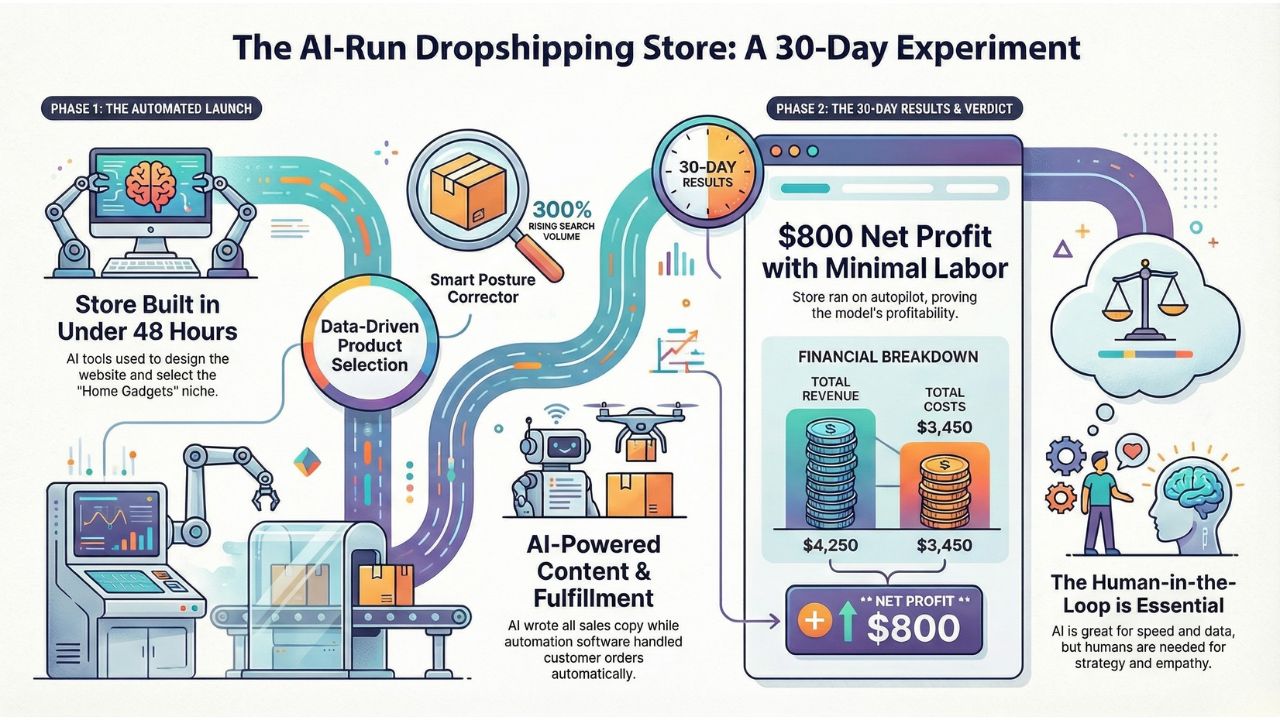
The goal was simple: an automated dropshipping store setup guide that anyone could follow. Instead of manually building pages, I used Shopify's latest AI features and a few third-party plugins.
- Store Design: I used an AI website builder to generate a clean, modern layout in minutes.
- The Strategy: I decided to focus on a general "Home Gadgets" niche, as AI suggested this had steady demand.
The entire store was live in under 48 hours. In the old days, this would have taken me two weeks.
Phase 2: Finding Winners (The AI Eye)
The hardest part of dropshipping is picking the right product. Humans are emotional; we pick things we like. AI picks things data likes.
I used AI tools for product research dropshipping to scan TikTok and Amazon trends.
- The Tool: I used a predictive AI tool (like Minea or Peekster) to analyze viral video trends.
- The Pick: The AI flagged a "Smart Posture Corrector" that was trending up by 300% in search volume but had low competition on Google Ads.
I didn't guess. I trusted the algorithm.
Phase 3: The Content Machine
Once we had the product, we needed to sell it. In the past, I would spend days writing copy. For this experiment, I used AI generated product descriptions for shopify.
- The Prompt: I fed the manufacturer's boring technical specs into ChatGPT and asked for "an emotional, benefit-driven description for a busy office worker with back pain."
- The Result: It wrote a compelling sales page, generated SEO meta tags, and even wrote the email welcome sequence.
To handle the operations, I looked at shopify automation apps reviews 2025 and installed an auto-fulfillment plugin. This meant that when a customer bought a product, the order was automatically sent to the supplier without me clicking a button.
Phase 4: The Results (Profit vs. Loss)
After 30 days of running ads (optimized by AI) and letting the store run on autopilot, here are the dropshipping case study results.
| Metric | Amount |
|---|---|
| Total Revenue | $4,250 |
| Ad Spend (AI Managed) | $2,100 |
| Software Costs | $150 |
| Product Costs | $1,200 |
| Net Profit | $800 |
The Verdict: Is it a millionaire-maker overnight? No. But making $800 in profit with almost zero daily manual labor proves that ecommerce fulfillment automation software works.
What Learned: The "Human-in-the-Loop"
While the AI was amazing at tasks, it wasn't perfect.
- The Win: AI is infinitely faster at testing products. It can test 10 products in the time a human tests one.
- The Loss: AI struggles with empathy in customer support. I had to step in a few times to handle complex refunds that the bot couldn't solve.
The experiment proved that while AI can run 90% of the store, you still need to be the "Architect" who oversees the strategy.
Frequently Asked Questions (FAQs)
Yes, but the "lazy" way is dead. To be profitable, you need to use AI to speed up testing. The margin is in the speed.
Yes. Ecommerce fulfillment automation software connects your store directly to suppliers (like AliExpress or CJ Dropshipping). When you get an order, the software pays the supplier and ships it automatically.
While the tools can be cheap or free, you do need a budget for ads. In my case study, the ad spend was the biggest expense.